Contributors

If you’re a U.S. company getting serious about going international, Europe is the best place to start. The consumer market is huge, the infrastructure is reliable, and the rulebook is clear.
But here’s the catch: Europe is not one market. This means that what worked at home will not always land in London, Amsterdam, or Berlin.
The way people buy, pay, hire, tax, and protect data all changes by country. How you handle those details will determine whether you build momentum or burn time and budget.
That’s why the right expansion approach matters. After successfully supporting countless U.S. companies expanding to Europe, we’ve seen what works, and what doesn’t.
Today, we’re letting you in on the decisions that matter most for a first European launch: why Europe, where to begin, and how to execute without costly detours.
Short answer: it’s the clearest path to turn U.S. traction into reliable international revenue, fast and with less risk.
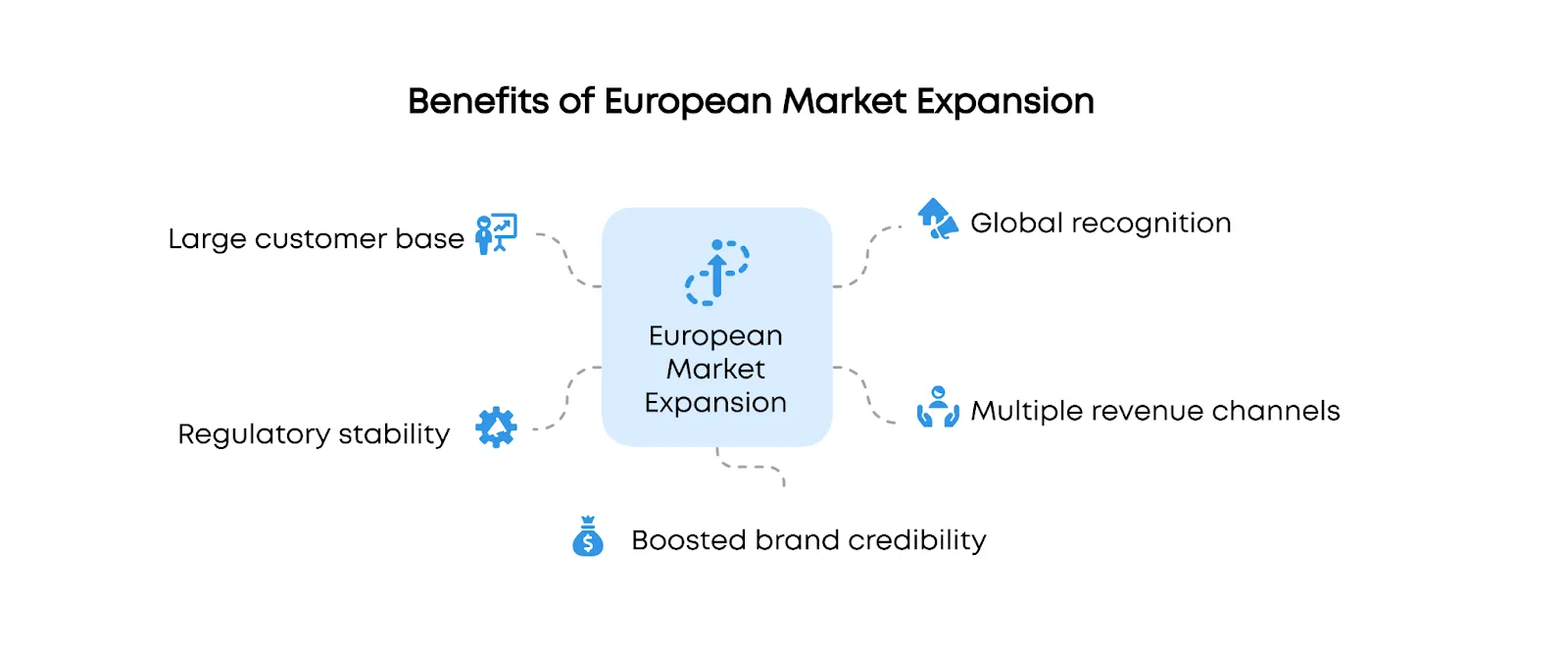
There are multiple benefits to expanding into Europe, including:
If that’s the kind of lift you’re after as US companies expanding to Europe, the next step is simple: decide where to land first.
Before you choose where to expand, it’s good to zoom out and get a better understanding of each market.
After all, Europe is a set of distinct regions, each with its own language reality, buying habits, payment norms, and pace of doing business.
Here’s a quick snapshot of the main European regions and their quirks:
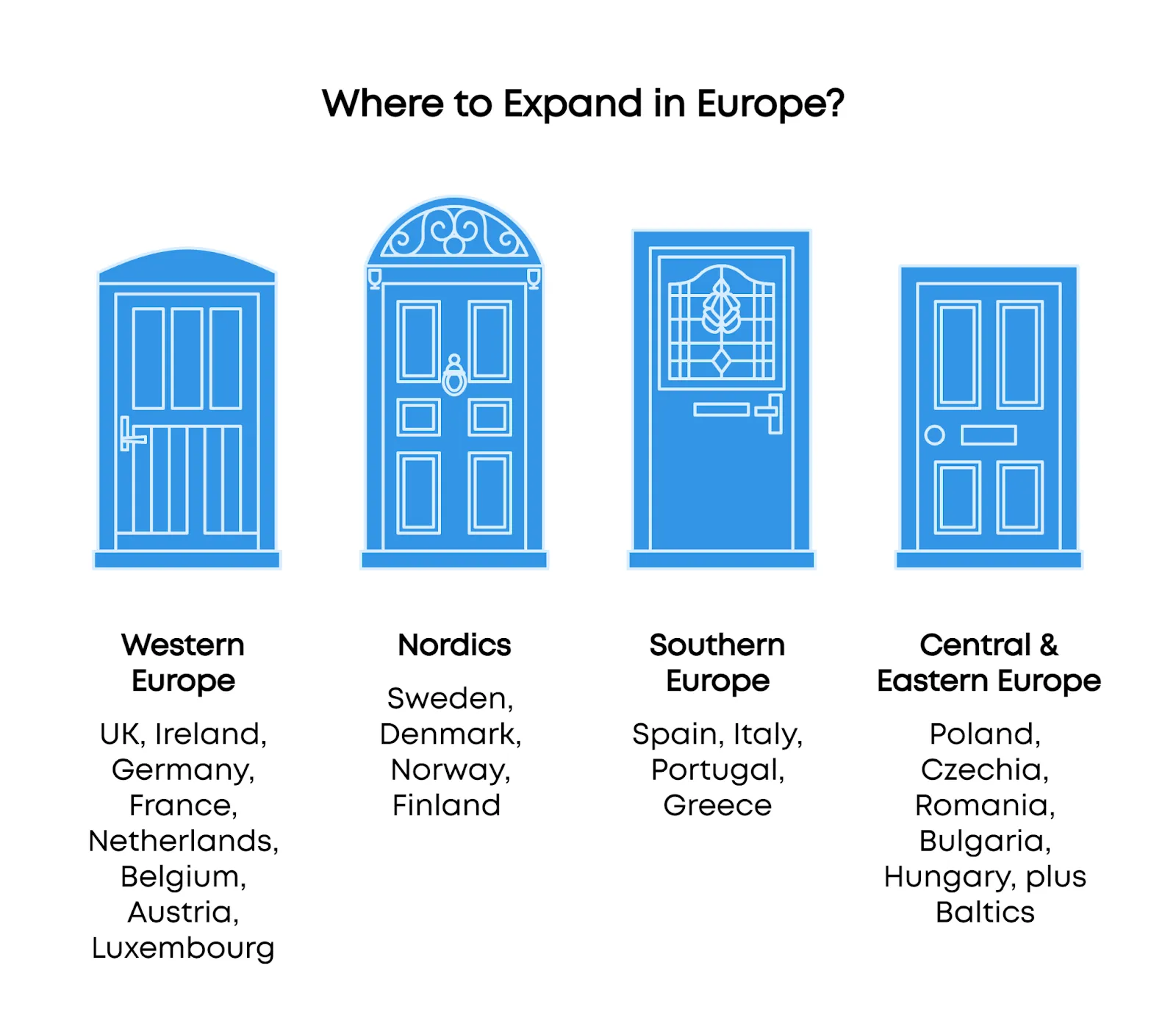
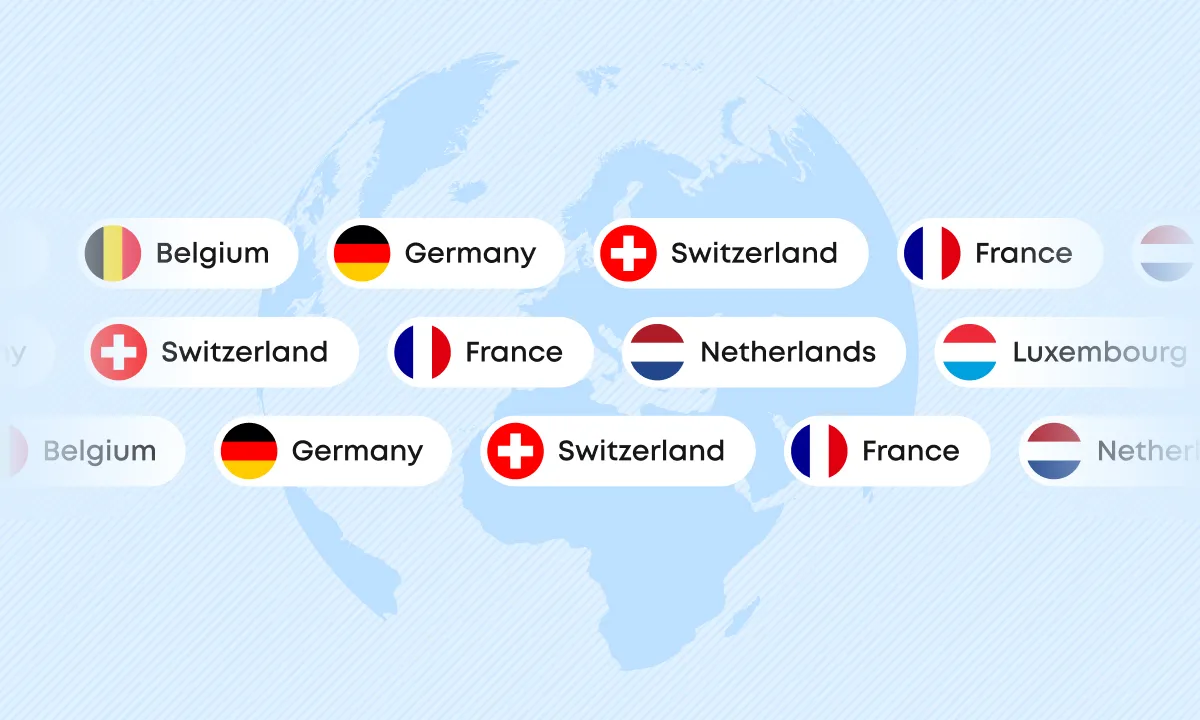
Countries in Western Europe: UK, Ireland, Germany, France, Netherlands, Belgium, Austria, Luxembourg
What it’s like: Mature buyers, clear rules, and deep partner ecosystems. Great for early credibility and repeatable expansion.
How they buy: RFPs and procurement checklists are common; proof, references, and compliance docs move deals.
Payments to expect: Cards + SEPA; iDEAL (NL), Klarna, giropay/SOFORT (DE), Carte Bancaire (FR).
Language: English works to start in NL/BE/IE; German/French lift conversion and trust in DE/FR.
Countries: Sweden, Denmark, Norway, Finland (Iceland smaller but similar)
What it’s like: Digitally advanced, sustainability-minded, premium positioning. Smaller populations, high expectations.
How they buy: Value clarity and transparency; short, direct cycles if the product is proven.
Payments to expect: Cards, Swish (SE), strong wallet usage; seamless checkout is a must.
Language: Very high English proficiency, localization still helps for brand depth.
BrainDonors Tip: Lead with proof and product quality over hype. ESG credentials and accessible documentation win points.
Countries in Southern Europe: Spain, Italy, Portugal, Greece
What it’s like: Big consumer potential and brand affinity; more relationship-led sales and price sensitivity.
How they buy: Trust first – local partners, distributors, or influencers accelerate adoption.
Payments to expect: Cards, wallets; installment options popular for consumer; cash-on-delivery still exists in pockets.
Language: Local language is a conversion lever (ES/IT/PT). English-only sites underperform.
BrainDonors Tip: Budget time for seasonality (e.g., August slowdowns). Invest early in local content + social for brand lift.
Countries in CEE: Poland, Czechia, Romania, Bulgaria, Hungary (plus Baltics: Estonia, Latvia, Lithuania)
What it’s like: Rapid digital growth and excellent technical talent; purchasing power varies by country.
How they buy: Pragmatic and ROI-driven; local testimonials and sharp pricing help.
Payments to expect: Cards, bank transfer; some markets retain COD; wallets rising.
Language: English workable in tech; local language helps for consumer and public-sector work.
So, now that you know a bit more about the markets, it’s time to decide which one or ones you should go after.
The first thing you should do is run these four quick checks:
Once you’ve answered these, you can start shortlisting your best options. Use the table below as a quick overview of your main options:
Once you’ve found your where, it’s time to tackle the how.
Okay, so you’ve picked your landing markets. Now it’s time to make your entry as smoooooth as possible. Below you’ll find our practical, no-drama guide we use with US companies expanding to Europe.
When we talk about localization, we don’t mean a full rebuild. We mean removing any little bits of friction so a buyer in Paris or Munich doesn’t have to think twice. It’s about creating a welcoming, relatable experience for each market.
In practice, that means speaking the local language on your core pages, showing dates the way locals write them (DD.MM.YYYY where expected), using cm/kg instead of inches/pounds, and making sure address and postcode fields just work.
Prices should also appear in the local currency with the right tax display, checkout should offer payment methods people already trust, and your visuals and color cues should match local taste and cultural nuance.
Oh, and support should feel close, too. Make sure it is easy to reach, in the local language, during local hours. No call center needed to start, just a clear, friendly path to a human.
Get these basics and small details right, and you’ll come across as a real local, something European buyers reward with trust and conversion.
With the foundation set, the next step is a marketing strategy that brings the right people to this localized experience. From our work with US companies expanding into Europe, here’s what works best:
Start with a solid market entry strategy. Who are you targeting? What pain points are you solving? Where do buyers here spend their time online? The answers form your base layer: the focus point that keeps every campaign aligned and efficient.
Be findable. SEO is your long-term demand builder. It’s not just about translating pages but optimizing content for local keywords, fixing technical issues, and earning country-level backlinks. A healthy site with fast load times and relevant content will keep you visible and trusted.
And while SEO is playing for the long game, we put into action paid campaigns like Facebook, Instagram, LinkedIn, and Google to give you immediate traction.
Pick the right channels. Each market has its own go-to platforms. In the UK, Benelux, and DACH, Google and LinkedIn often drive B2B results. In Southern Europe, Meta and TikTok perform better for lifestyle and D2C. The rule of thumb here: whatever the channel, the message needs to resonate.
Track what matters. Keeping an eye on how your efforts are doing can help you see what’s driving results and what’s not. Based on that, we can adapt.
Connect marketing to sales. Make sure every lead flows to local reps or partners, with follow-ups in the right language and quick response times. This makes the buyer feel they’re dealing with a true local business, not just a US brand operating abroad.
Pro tip: Having a sales and marketing team well-versed in different European values and is what will ensure your success in this mosaic market.
A strong marketing strategy has many moving parts. From SEO and paid campaigns to content, influencers, email, and tracking – each piece matters.
Make your business feel truly local in every market with tailored strategies that speak your customers’ language.

Did you know that Europe speaks in 24 official languages? And behind each one are unique cultural expectations.
While English is widely spoken, relying on it alone puts a ceiling on your growth. If you want buyers to truly engage, you need to also speak their language and show you understand how business is done locally.
That goes beyond translation. A French buyer expects copy that feels like it was written for them, not just converted word for word. German customers value precision and detail in communication. In Southern Europe, people respond better to warmth and relationship-building.
Even your visuals, colors, and tone of voice can tip the scale between trust and hesitation.
Localization plays a key role in market expansion, but it doesn’t need to be a big upfront investment. Begin by reusing core content across languages to test markets efficiently, then refine and localize more deeply as your business scales.
When you do this, your brand stops feeling foreign and starts becoming familiar. In Europe, that matters, because recognition and trust are what drive adoption and long-term loyalty in Europe.
Pricing in Europe is never one-size-fits-all. What feels competitive in Western Europe may be unrealistic in Eastern Europe, and the same product can be perceived very differently depending on the market.
That’s why like everything else your pricing strategy also needs to be localized.
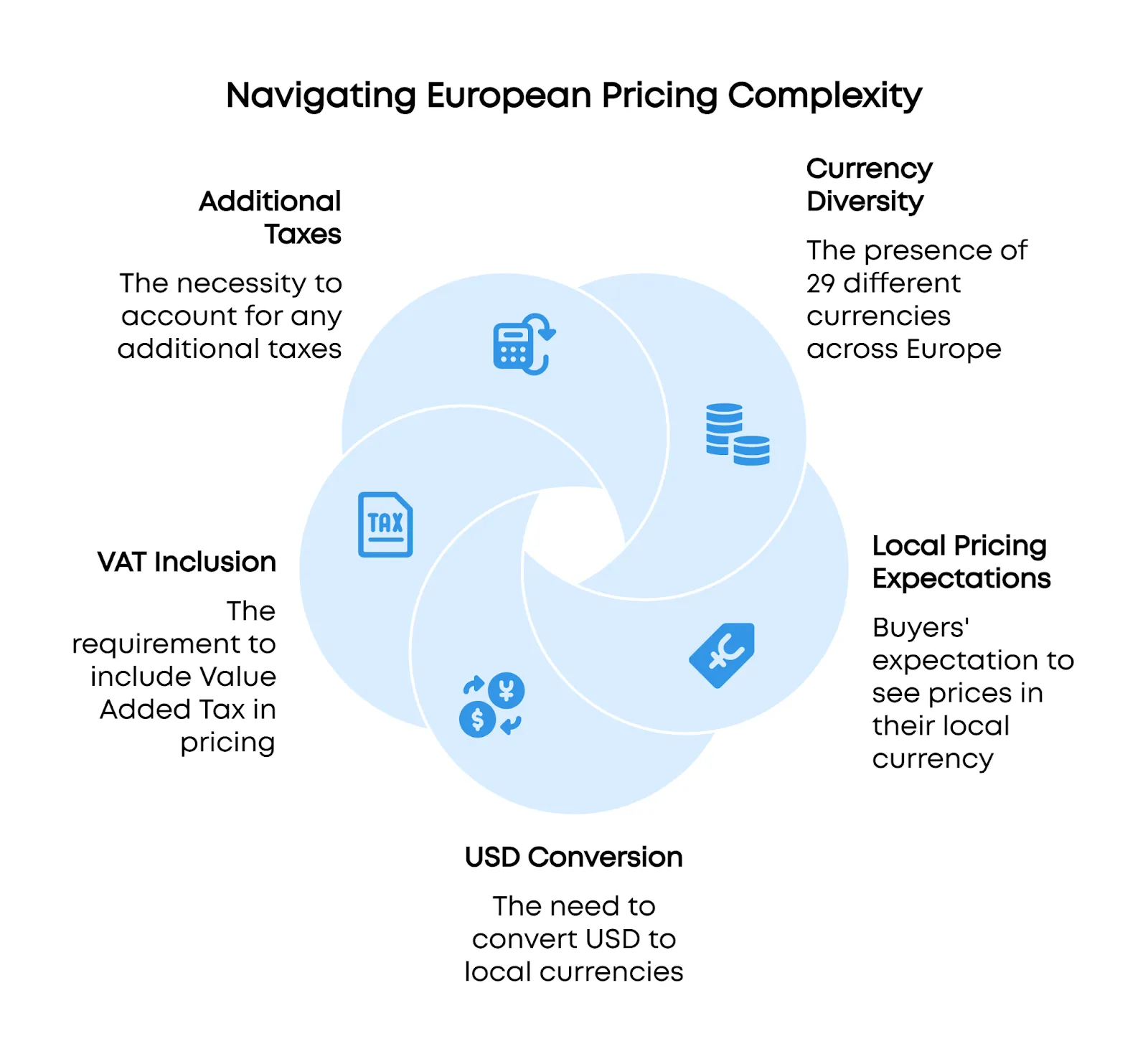
Let’s start with the basics: there are 29 different currencies across Europe, and buyers expect to see prices in their own. That means not just converting USD but showing clean local pricing, with VAT and any additional taxes included.
Beyond currency, you also need to think about price sensitivity by market. In some countries, customers may pay a premium for speed, quality, or brand; in others, affordability will be the main driver.
Tracking local competitors and adapting accordingly is what keeps you relevant.
And finally, don’t underestimate economic context and trust factors. Payment methods, display of taxes, and clarity on returns all play into whether a buyer feels comfortable completing the purchase.
Pro tip: With multiple currencies in play, it’s smart to start with regions that share similar interests, proximity, and ideally the same currency. This keeps operations simpler and helps you test and scale faster.
When it comes to regional preferences, markets in Central and Eastern Europe tend to respond strongly to promotions, bundles, and competitive pricing. In contrast, Western Europe and the Nordics place higher value on quality and brand trust, though they still appreciate thoughtful freebies or small bonuses, even at a slightly higher price point.
Regulation is part of doing business in Europe, and it’s one of the areas where US companies often underestimate the complexity. Each market has its own rules, and getting them right from the start saves you time, money, and headaches later.
Getting ahead of these requirements not only helps you avoid fines but also builds credibility with European buyers, who see compliance as a mark of trust and professionalism.
Pro tip: Consider implementing a proper cookie management system and regularly reviewing your terms and conditions, privacy, and return policies. If you’re unsure where to start, no problem, our in-house legal consultant can guide you through every step.
Even with a great product and a good game plan, expanding into Europe still comes with a learning curve. From our experience, these are the areas where companies often run into challenges, and how to sidestep them.
Keep in mind: Expanding internationally will always come with adjustments, but avoiding these common pitfalls helps create a smoother path. With the right strategy, research, and execution, growth in Europe becomes much more predictable.
We’ve covered the key parts of your future expansion and the pitfalls to avoid. Now let’s pull it all together into a clear, step-by-step process.
Here’s how to get started:
Step 1: Align strategy and compliance
Before anything else, make sure your business strategy, legal setup, and compliance basics are in order. This means understanding VAT, GDPR, employment law, and any sector-specific regulations in your chosen country. Getting this right early prevents costly fixes later.
Step 2: Choose your beachhead market
Don’t try to launch everywhere at once. Pick one or two countries where demand and product fit are strongest. Use clear criteria: inbound signals, competitor presence, speed to operate, and hub potential for future expansion.
Step 3: Localize for trust
Adapt your website, pricing, and support for the local market. Language, currency, payment methods, and cultural cues matter. Even small touches, like date formats or customer service hours, can increase trust and conversion.
Step 4: Build your demand engine
Set up a marketing strategy that fits the country. This means SEO with local keywords, paid campaigns on the right platforms, localized content, and influencer/partner activations. Track performance from day one with HubSpot or GA4 so you know what’s working.
Step 5: Connect marketing to sales
Make sure leads flow smoothly into sales. Use local reps or partners, follow up in the right language, and keep SLAs tight. A fast, local response shows you’re serious about the market.
Step 6: Test, learn, and scale
Treat the first market/markets as your pilot. Measure results, adapt quickly, and once you see traction, expand into neighboring countries. Each new market will be easier and cheaper if you build on the first.
Expanding into Europe is a big step, but it doesn’t have to be overwhelming. With the right approach to strategy, localization, and market entry, it becomes a clear path to new revenue, stronger customer relationships, and global credibility.
We’ve walked this path with plenty of US companies, and the pattern is always the same: the ones who prepare well, win faster.
If you’re ready to explore Europe as your next chapter, we’d be glad to help you build a plan that works.
The US exports a wide range of goods and services to Europe, with top categories including machinery, vehicles, pharmaceuticals, medical equipment, and aerospace products. Digital services, software, and entertainment also make up a large and growing share of US exports to the region.
Popular destinations include the United Kingdom, Germany, France, Portugal, and Spain. Many Americans relocate for work opportunities, lifestyle, or easier access to other EU markets. Portugal and Spain, in particular, attract entrepreneurs and remote workers thanks to their business-friendly visas and lower living costs.
Key regulations include GDPR for data protection, VAT for taxation and pricing, CE marking for product compliance, and sustainability directives such as EPR (Extended Producer Responsibility). For digital businesses, new frameworks like the Digital Services Act (DSA) and Digital Markets Act (DMA) are also essential to understand.
Start by researching your target markets, identifying regions with similar buyer behavior or shared currencies, and setting up the right legal and financial structure. Adapt your website, content, and support to local languages and regulations, and build trust through transparent policies and localized marketing. Partnering with local experts or agencies can speed up entry and reduce risks.