Contributors


Your B2B demand generation strategy is producing leads.. just not the right ones.
We hear this constantly from B2B marketing and revenue teams: volume looks healthy, cost per lead seems acceptable. But the SQLs are thin, the sales cycle is long, and too many deals are stalling at the evaluation stage.
And the issue is that most B2B demand generation programs are built around capturing the bottom of the funnel without doing the upstream work that makes that capture convert. They invest in conversion before credibility, and in campaigns before infrastructure.
Across 300+ B2B campaigns, the programs that produce consistent high-intent pipeline all start from the same place: a clear demand assessment, the right system for that market, and the patience to build it properly.
So if your demand gen is running but your pipeline quality isn't where it needs to be, this guide is for you.
The B2B demand generation tactics that produce high-intent pipeline depend on one prior step: assessing how much demand already exists in your niche.
Scenario 1: Demand exists. Buyers are actively searching. Your job is to capture it through search channels.
Scenario 2: Demand doesn't exist yet. The market is unaware. Your job is to create it through display and social channels before you can capture anything.
And once you know which situation you're in, three parallel systems do the work: Visibility (getting found), Credibility (earning trust), and Conversion (capturing intent).
Below are the four specific strategies that run across all three.
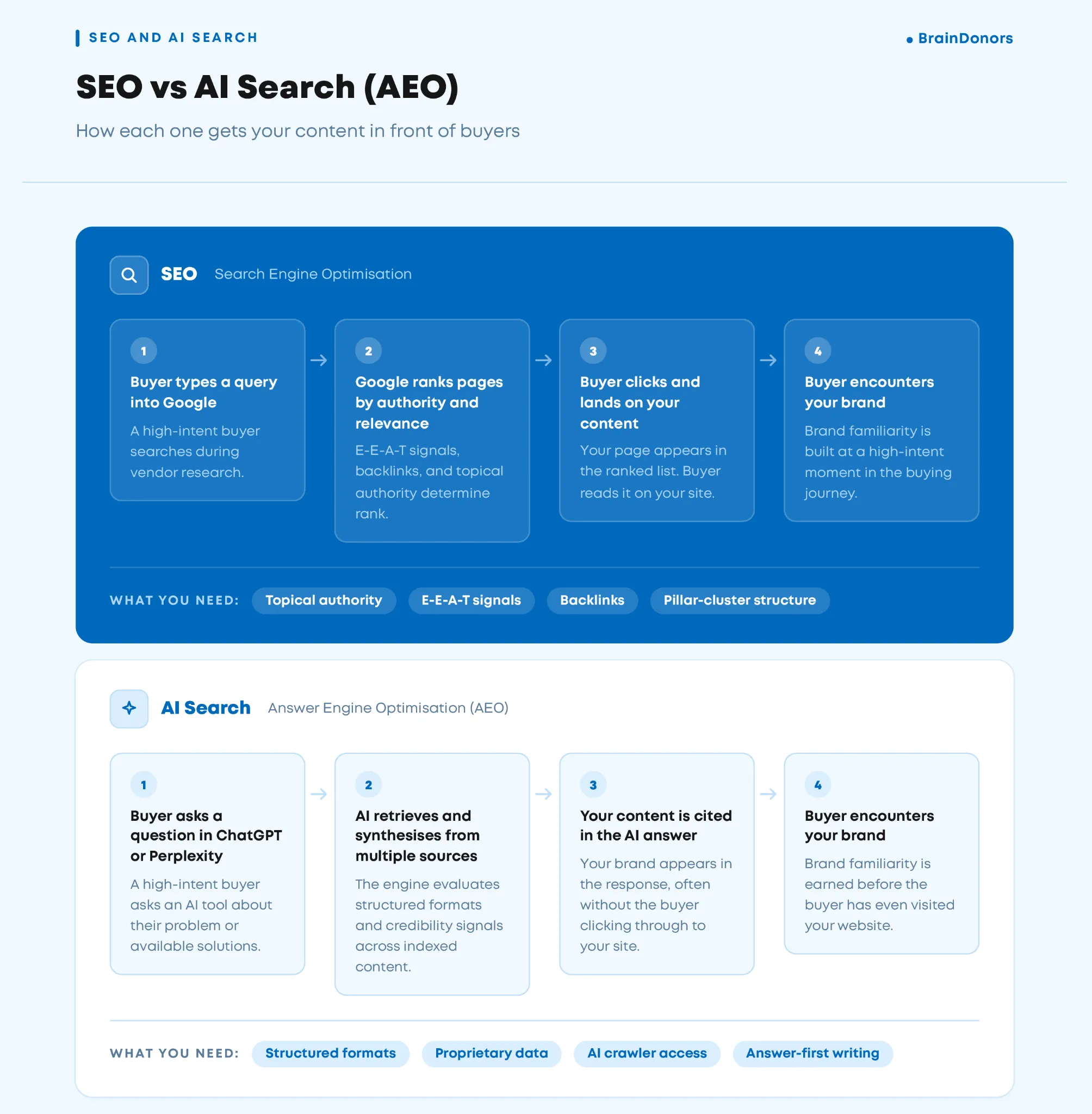
Capturing high-intent leads from buyers already in research mode requires two parallel investments: a B2B SEO strategy that ranks for the queries your buyers use during vendor evaluation, and a generative engine optimization strategy that gets your content cited in ChatGPT, Perplexity, and Google AI Overviews.
Together, they make sure you're present wherever a high-intent buyer is researching, whether that's a search engine or an AI tool.
To understand why both SEO and AI Search (AEO) matter, it helps to see how differently they surface content to a buyer:
Creating demand in a market that isn't yet searching for you requires paid social and display channels that build brand familiarity before intent forms.
The goal at this stage isn't conversion, but making sure that when your ICP eventually starts researching, your brand is already in their head.
And this is where most B2B companies underplan. They assume the market is searching, invest in SEO and paid search, and get confused by the low volume and high CPCs.
But sometimes the problem isn't execution, it's that the demand simply doesn't exist yet at the scale they're targeting.
A B2B Google Ads strategy plays a different role: it handles demand capture through high-intent branded, competitor, and solution-aware keywords. In most cases, we run search and display in parallel, with separate measurement frameworks for each.

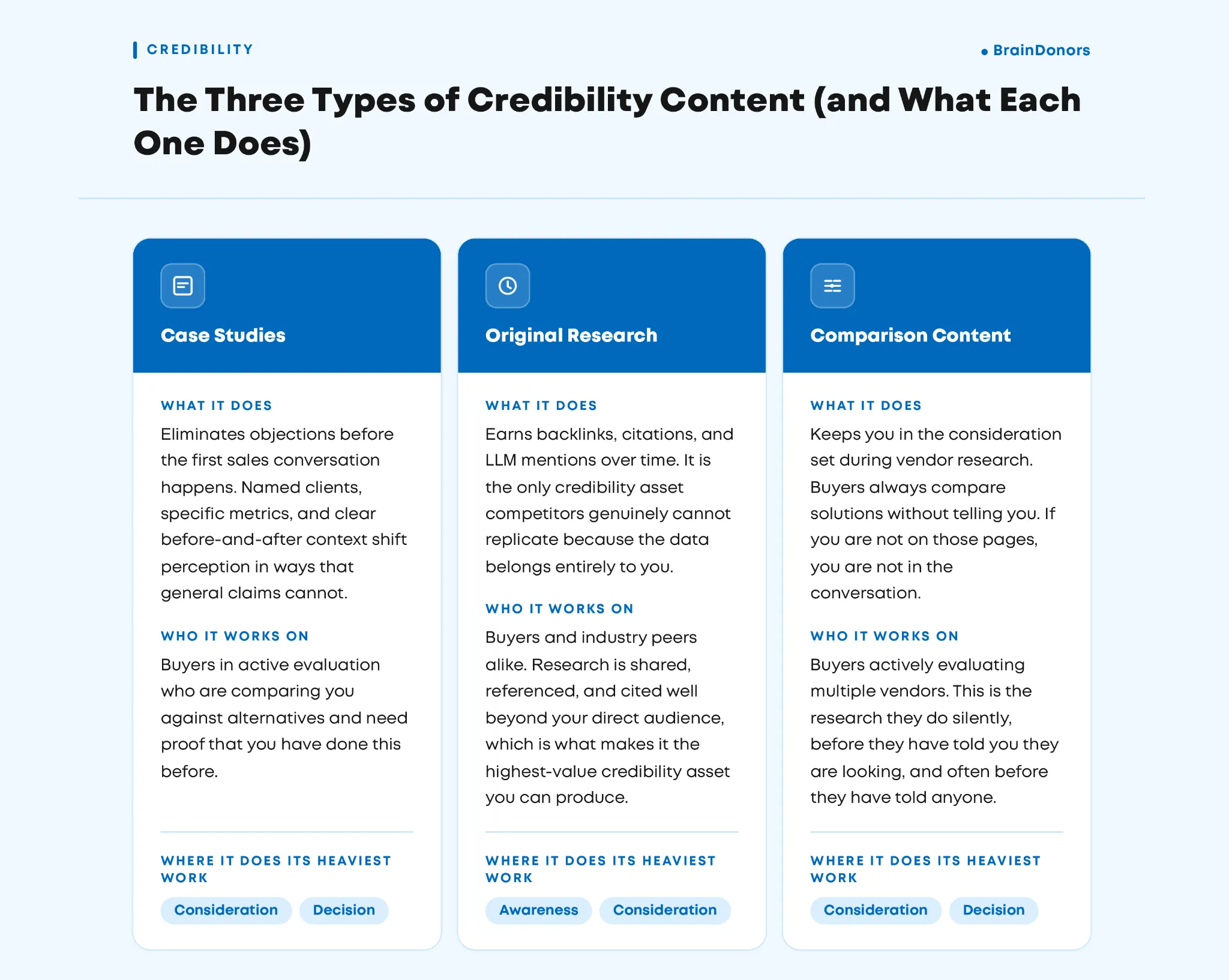
Turning B2B awareness into pipeline preference requires good B2B content marketing built around proof: case studies with named metrics, original research competitors can't replicate, and comparison content that puts you into vendor shortlists at the moment buyers are actively evaluating.
Without this layer, Visibility generates traffic that never converts into genuine buying preference.
Most pipeline quality problems we diagnose aren't awareness problems. The people who know you exist don't trust you enough yet to choose you.
And that's a credibility gap, and proof-based content is what closes it.
Each of the assets does a different job at a different point in the buying journey.
Here's how we think about which one to deploy, and when:

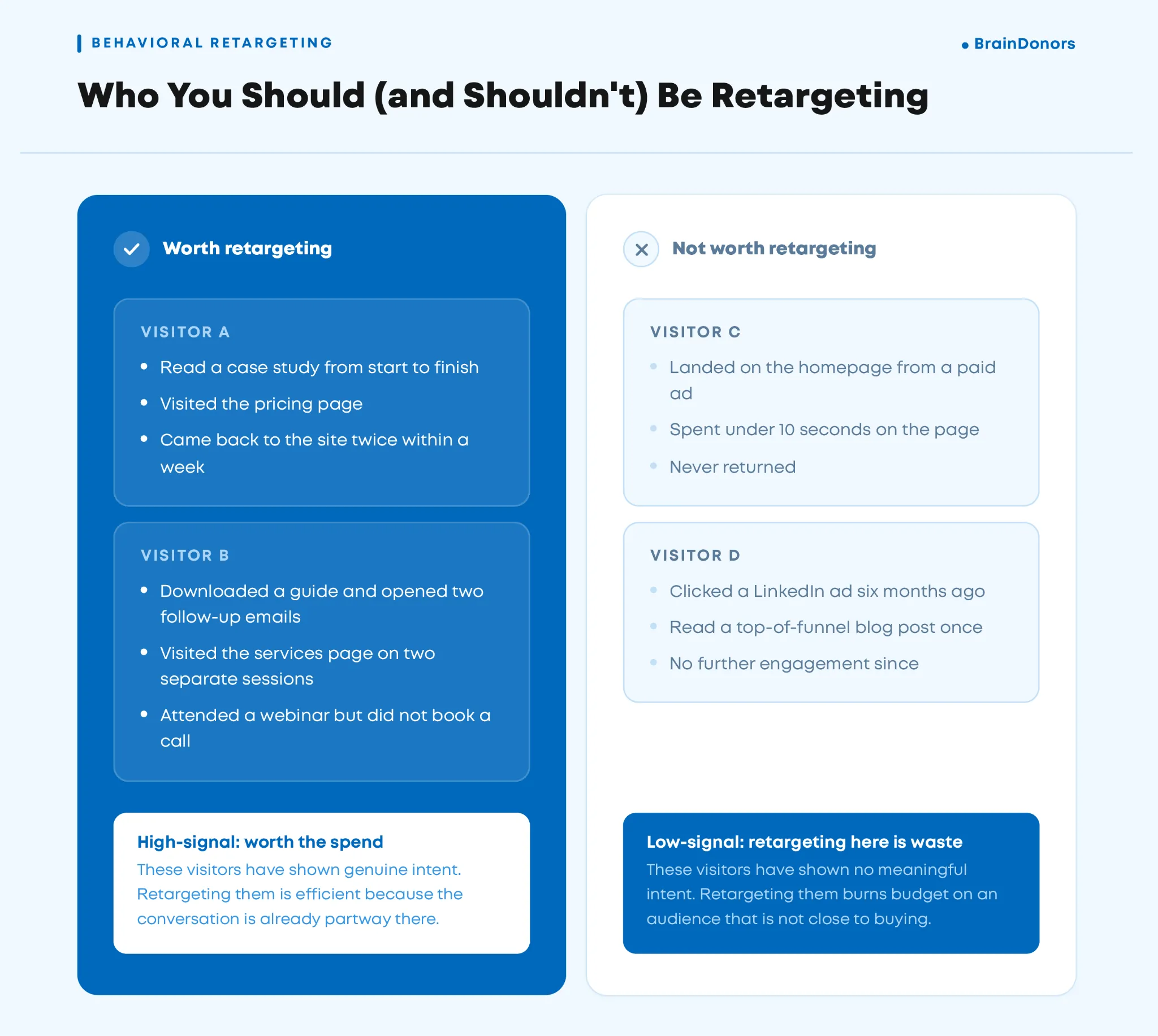
Activating and converting high-intent B2B accounts requires ABM that targets accounts already showing purchase intent signals, combined with behavioral retargeting that segments visitors by depth of engagement rather than just presence.
Both tactics only deliver strong ROI when Visibility and proof-based content have already established brand familiarity upstream.
But when it comes to retargeting, not all website visitors are worth following. Here is an example how to tell the difference before you spend:
The fix isn't more conversion spend, but building the upstream systems first!
All four strategies feed into one final layer: sales enablement. This is where the demand you've generated gets processed into actual pipeline.
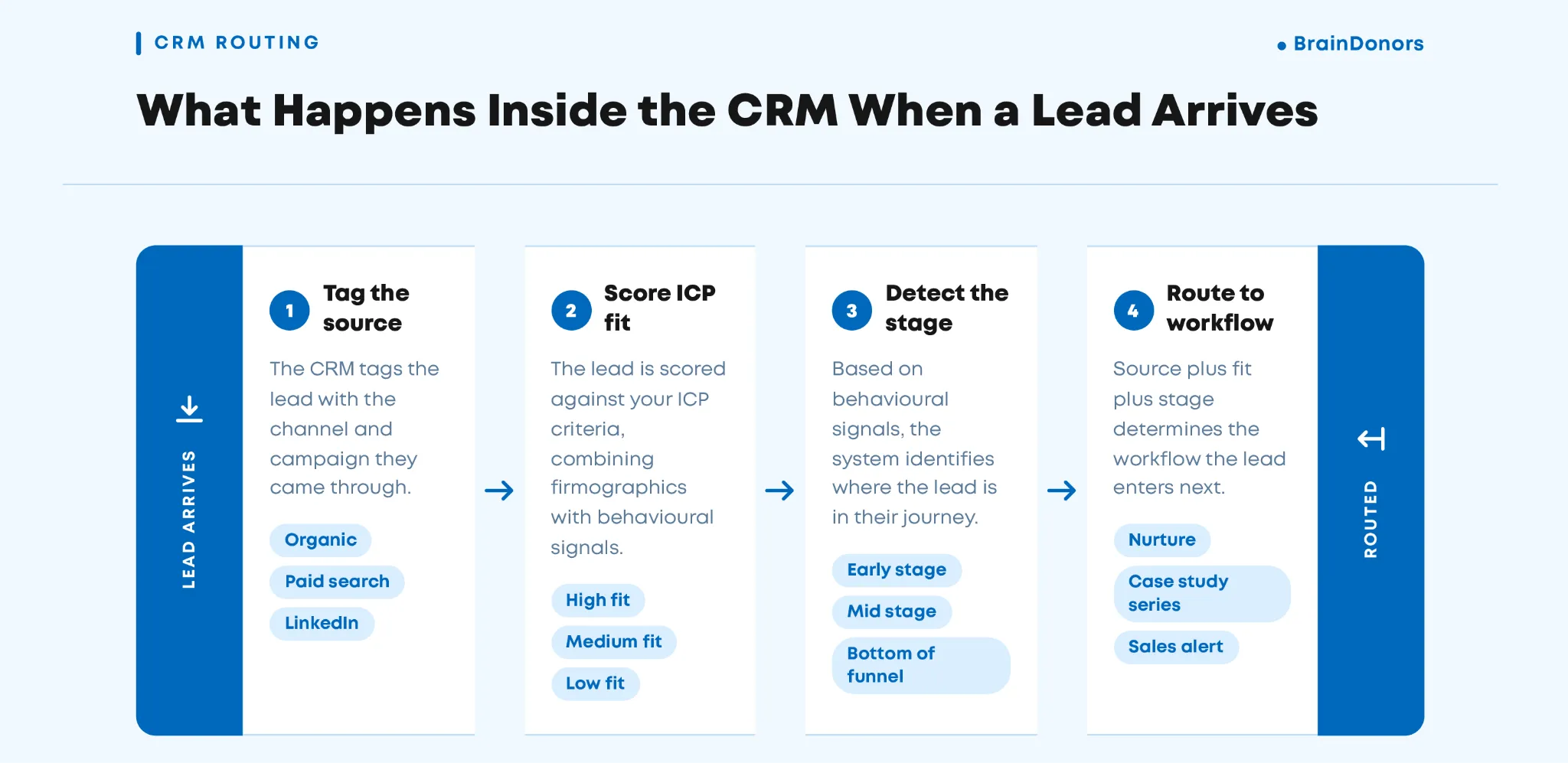
A lead comes in, it gets routed into your CRM, qualified against your ICP, and then either handed to sales or entered into a nurture sequence depending on its stage and characteristics. Without this layer, you've done the hard work of building awareness and trust, and then dropped the ball at the moment it matters most.
The automation section later covers exactly that.
At its core, demand generation is a constant battle between building trust and educating your audience. You produce content, you distribute it to the right channels, you attract the right audience, and you measure how you're doing monthly, quarterly, and yearly.
It really is that simple, the complexity is in the execution.
Now, none of this works without the right technical foundation underneath it. Which brings us to the part most companies overlook: technical infrastructure.
B2B demand generation requires six infrastructure layers before any campaign goes live: a documented ICP strategy, a high-converting website, a CRM, a webinar tool, a deal management system, and attribution reporting.
Ask any experienced B2B demand generation agency and they'll confirm the same thing: most demand gen failures aren't strategic, they're infrastructure failures.
Yes, the strategy is fine, the campaigns are decent. But the foundation underneath them… is broken, so nothing compounds.
Before any campaign goes live, you need six things in place. (We're serious about this. We've seen too many clients burn budget on campaigns that had nowhere to land.)
Before any tool, before any campaign, you need to know exactly who you're going after, which channels they use, and how to approach them.
Everything downstream depends on this being right.
We can't stress this enough (and we say it to almost every new client 😫).
All the traffic you generate, from every channel, every campaign, every piece of content, eventually ends up on your website.
A buyer who sees your LinkedIn content, clicks through, and hits a weak or confusing website is gone. And most of the time, people submit their contact details and make first contact through the website.
Which means that if it's not built to convert, you're generating demand you can't capture.
When someone submits a request, what happens next?
Who sees it?
How is it processed?
Without a CRM, leads arrive and disappear. HubSpot covers CRM and marketing automation natively, which is why it's the infrastructure foundation we build most demand gen programs on.
The alternative (stitching together separate tools) works well until it doesn't, usually at the worst possible moment. That’s why we don’t recommend it.
Webinars are a core mid-funnel channel (and one most B2B companies underuse). The tool needs to integrate cleanly with your CRM so that attendee behaviour feeds directly into your lead records.
Demand gen generates pipeline, but pipeline needs to close. Without a proper deal management tool, opportunities get lost in email threads and spreadsheets.
Yes, it's that straightforward.
Once you're spending across multiple channels, you need to know which activities are actually producing results.
For early-stage companies, basic UTM tracking connected to your CRM might be enough. For larger programs running multiple channels, you need a dedicated attribution modeling or data analytics tool.
And when you're generating demand across several channels at once, measuring ROI without attribution becomes almost impossible.
With the infrastructure in place, the next layer is automation, because without it, even a solid foundation produces leads that stall.
Marketing automation strengthens B2B demand generation by turning lead flow into a structured, measurable revenue process. Without it, leads arrive at different quality levels and stages with no system to handle them. With it, every lead gets routed, nurtured, and escalated based on where they are in the buying process, across channels like email, WhatsApp, SMS, LinkedIn, and calling.
Let's be clear about something: marketing automation isn't a nice-to-have, but it's how you monetize the demand you generate.
When your demand gen is working, leads arrive at all kinds of stages, quality levels, and sizes. Some are ready to buy right now. But most aren't.
Without automation, the leads that need nurturing get dropped, timing gets missed, and sales ends up working only the easiest leads while the rest of the pipeline quietly evaporates.
With the right automation in place, things look very different:
Here is exactly what should happen after a lead arrive:
And here is what happens when you don’t have a properly set marketing automation:
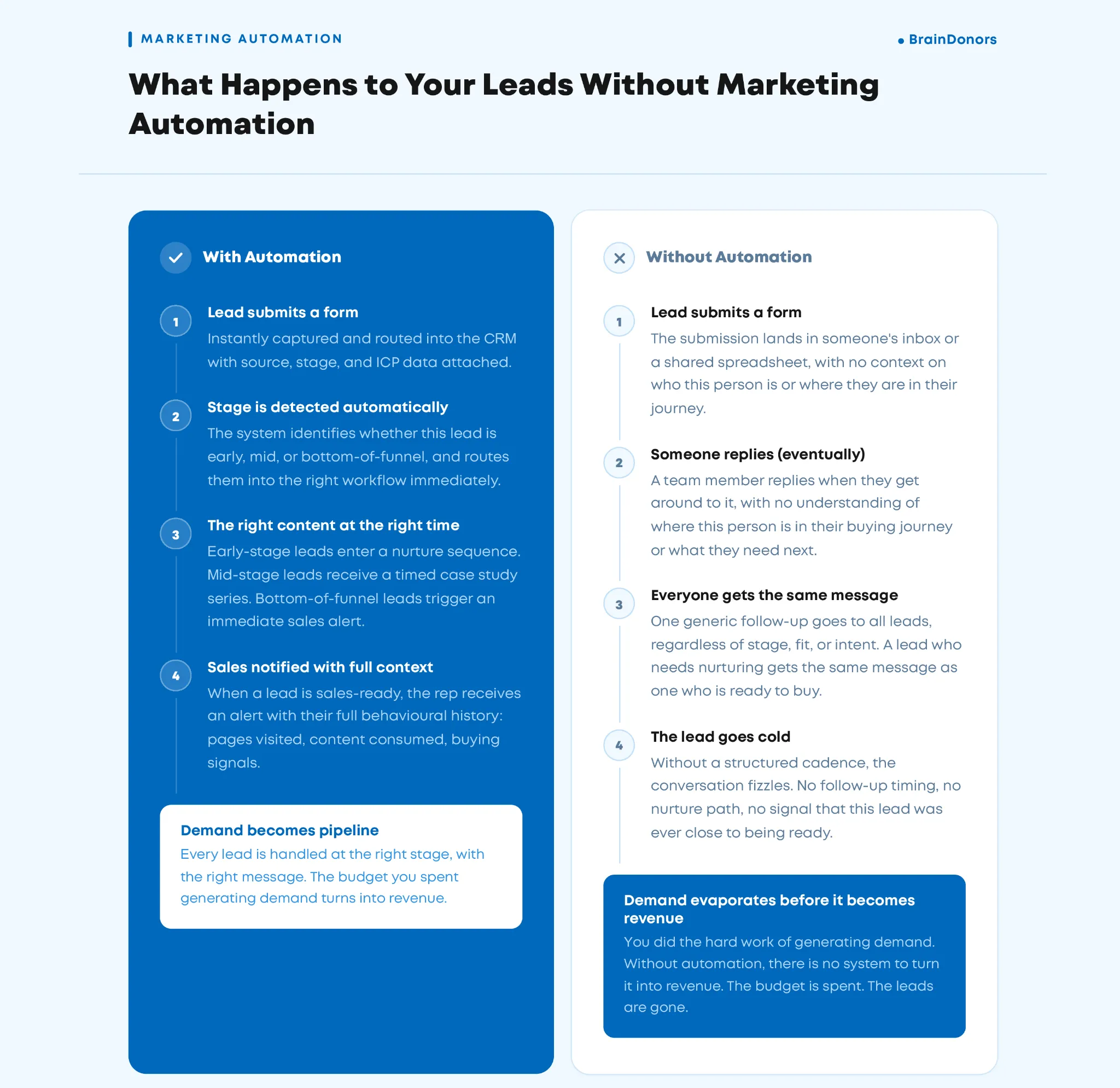
Automation can run across email marketing, WhatsApp, SMS, LinkedIn, and calling, depending on what your ICP responds to.
And the best programs we've built aren't fully automated. They're semi-automated. Sales does an action (a follow-up call, a personalised note), and then automation kicks in to reinforce the cadence and help them sell better.
And speaking of conversion, let's talk about paid media, because where and how you spend matters just as much as how much you spend.
Matching paid media to your demand generation funnel starts with one question: does demand exist to capture, or does it need to be created? If demand exists, invest in paid search and target high-intent keywords only. If it doesn't, invest in display and social channels to build awareness that makes future intent possible.
In most cases, we recommend a strategic mix of both.
Your paid media strategy also follows from the same assessment we covered in the first section. Is there existing demand to capture, or do you need to create it?
If demand exists:
Your paid goes into search-driven channels, specifically Google Ads targeting high-intent keywords. And the rule here is strict: high-intent searches only. Don't spend paid budget chasing broad or informational queries, go after buyers who are actively evaluating solutions.
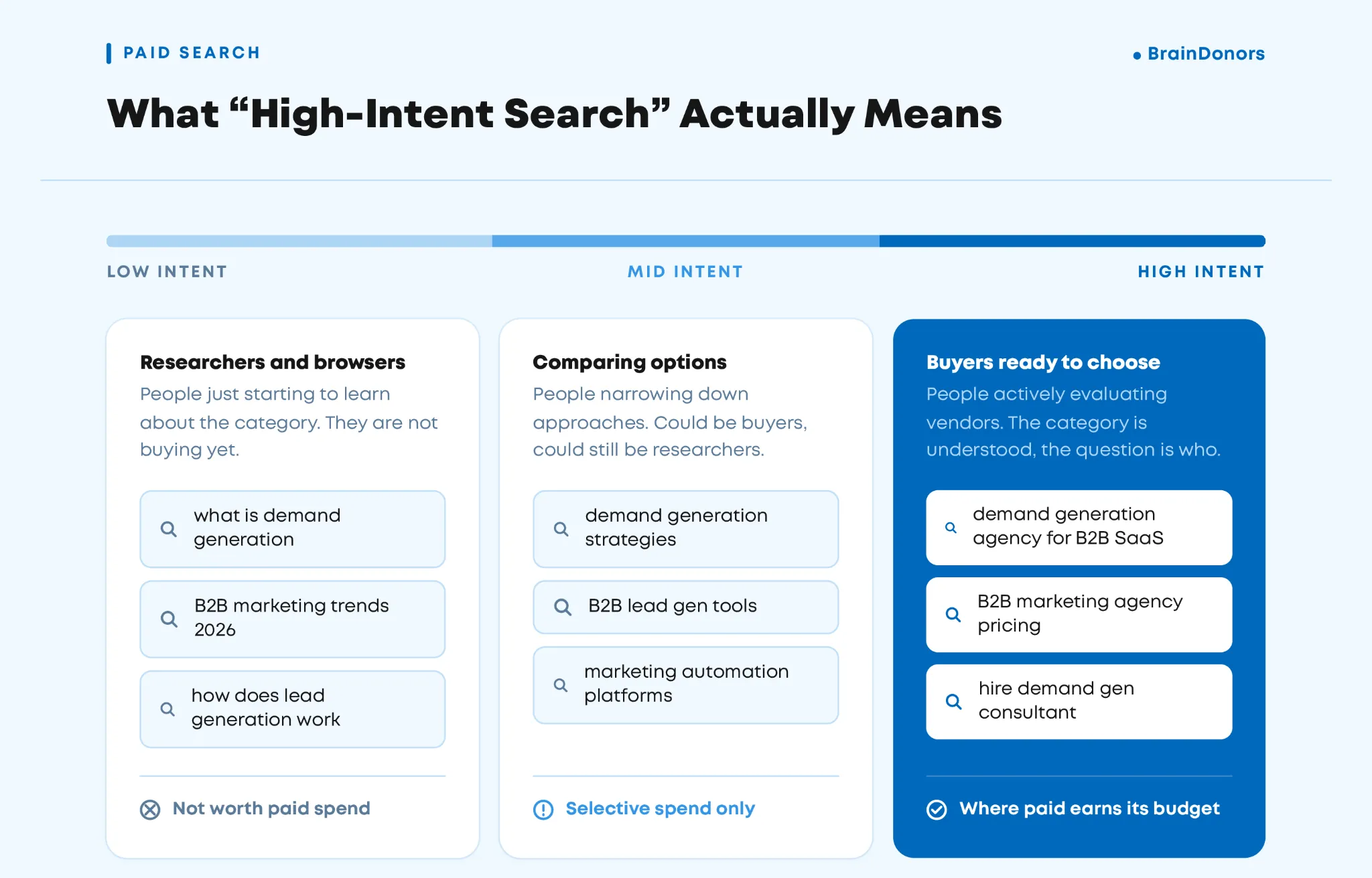
If demand needs to be created:
Your paid media shifts toward programmatic display, LinkedIn, Reddit, Meta, and niche publication placements. You're building awareness that makes future intent possible, not capturing intent that already exists.
Our recommendation in most cases is a mix of both. Here's the practical difference between them:
One thing worth planning for: if you start generating more leads than your sales team can’t handle, you've created a different problem.
So always scale paid media in line with your actual capacity to fulfil the demand you're creating on the sales side.
As mentioned earlier, the most common B2B demand generation mistakes that stall pipeline growth are almost always infrastructure mistakes, not strategic ones. The biggest three are running campaigns without a proper website, not having a CRM to consolidate leads, and skipping marketing automation and sales enablement.
A fourth, equally damaging mistake is expecting meaningful results within the first 30 to 60 days.
This is probably our personal favourite topic, because these mistakes are so avoidable, and yet we see them constantly, across many company sizes and budgets.
By now you must know that all your traffic ends up on the website. Every channel, every campaign, every piece of content leads there. So if it doesn't convert that traffic into trust and action, nothing closes.
We describe it to clients like this: it's like shooting arrows outside, and then when people come to your place, it's not tidy, it's not ready, and people are leaving confused. You basically fulfill only one part of the user journey and abandon the other.
So those leads you generated with real budget never make it further down the funnel.
A lead arrives, great! Then what?
Without a CRM, the answer is usually: someone replies eventually, it lands in a spreadsheet, or it gets forgotten entirely. The CRM is what turns demand into pipeline. It's where the handoff from marketing to sales happens with full context.
And without it, that handoff breaks every single time (we’ve seen it more times than we would like).
You can do all the marketing in the world, but without good sales enablement… you can't monetize those activities.
Leads come in at different stages and quality levels. Without workflows to route, nurture, and escalate them, and without enablement content to help sales close, and you generate demand that evaporates before it ever becomes revenue.
People aren't willing to play the long-term game. They want results in the first month or two, and when they don't see them, they cut the budget.
In B2B, things take time, and whoever plays for the longer term is always the winner. Playing the long-term game pays far more than short-term gains, every single time. We've seen this proven across hundreds of client programs.
You've seen the full picture now: the demand assessment, the three systems, the infrastructure requirements, automation, paid media, and the mistakes that drain budget before any of it compounds.
If we had to point to the single highest-leverage place to start, it's the infrastructure layer. Not the campaigns. Most B2B demand gen programs fail because the website doesn't convert, the CRM doesn't process, or automation doesn't exist.
Which means you can have the right strategy and still lose every lead in the plumbing.
So if your demand gen is already running but the pipeline isn't reflecting it, the problem is almost always in one of three places: the infrastructure, the handoff between systems, or the sequencing of the three layers.
As a B2B demand generation agency, we've built and audited enough programs to spot where it's breaking fast. So if you want a second pair of eyes on yours, get in touch with our team.
Start with a demand assessment: check the search volume around your product category and the problem you solve. If significant demand exists, focus on capturing it through search channels. If the market is largely unaware, focus on creating demand through display and social channels.
A B2B ICP should go beyond firmographics (industry, company size, job title) to include behavioral signals: which channels they use, what problems they're actively researching, and what buying triggers bring them in-market. The ICP also needs to be validated against closed-won data, not just assumed. Start with your best existing clients and work backwards to identify the common characteristics that made them a good fit.
Most programs take 3 to 6 months to show measurable pipeline impact, and 6 to 12 months to compound into a consistent engine. Display-driven campaigns for demand creation take longer to close than search-driven capture campaigns. Expecting results in 30 to 60 days is one of the most common (and most damaging) mistakes we see in the category.
An MQL meets your ICP criteria but hasn't yet shown active sales interest. An SQL meets your ICP and has explicitly shown sales intent, through a demo request, a direct inquiry, or a clear buying signal. We track both separately with their own volume and cost-per metrics, because the gap between them reveals exactly how well your nurture and qualification process is working.
Track the full progression: MQLs and cost per MQL, SQLs and cost per SQL, opportunities with pipeline value and characteristics analysis (enterprise vs SMB, region, product line), close rate, and closed-won revenue with ROI against marketing spend. For SaaS specifically, layer in CPA, churn rate, ARR and MRR, cost per free trial, free trial to paid rate, LTV, and average customer retention, all attributed back to the campaign or channel that sourced the user.