Contributors


If you’re a B2B SaaS company deciding where to play, Europe and the US offer very different opportunities and challenges. Knowing the differences can save you time, money, and headaches.
In this guide, we break down the key distinctions between the European and US B2B SaaS markets, from market size and growth to customer behavior, funding trends, and regulations.
By the end, you’ll have insights to help your SaaS product gain traction, delight customers, and grow strategically in the market that’s the best fit for you.
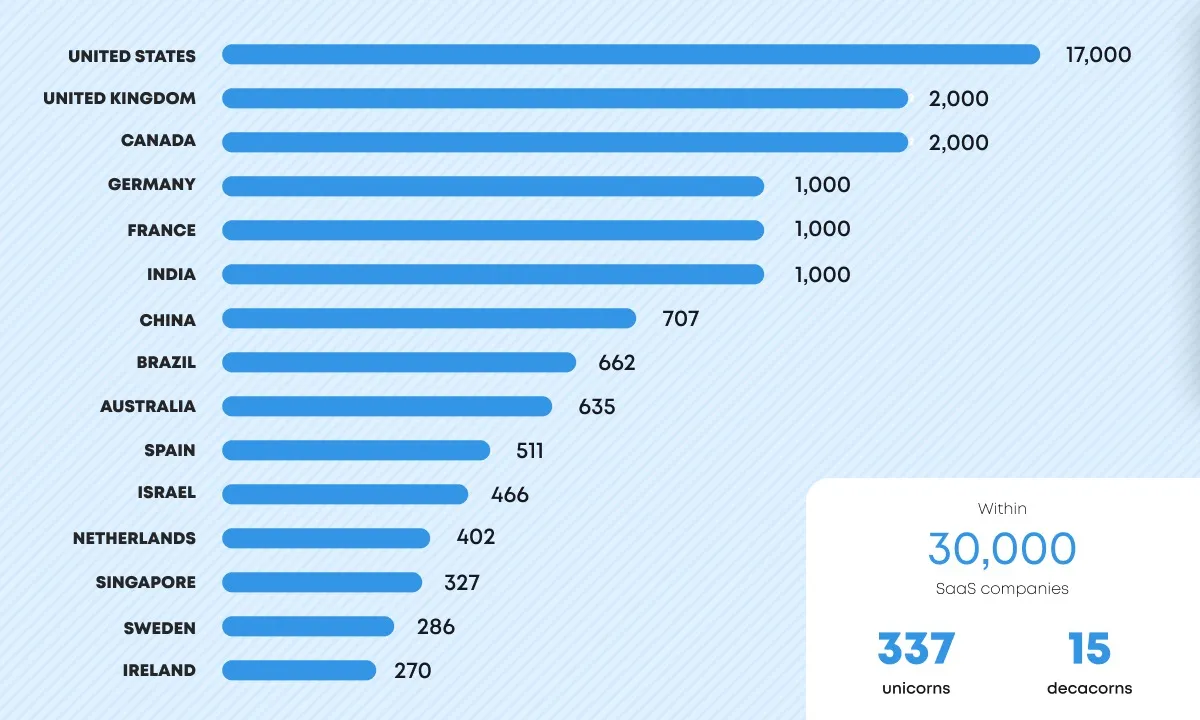
Reports by Statista show that there are over 30,000 SaaS companies worldwide. But who’s the bigger fish when it comes to B2B SaaS? Europe or the US?
Let’s break down the numbers and see which market is shaping up to be the ultimate home for SaaS businesses.
The US has cemented a clear position for itself as the global heavyweight, SaaS champion, and is leading the charge in SaaS innovation.
Sheer size
The US alone is home to over 17,000 SaaS companies. This is around 60% of the global SaaS industry. Pretty impressive, right? This huge number includes a diverse range of B2B and B2C solutions and innovations, from CRM systems to advanced analytic tools.
Market value
By 2024, the US SaaS market was valued over $190 billion, truly solidifying its status as a financial powerhouse in the industry. But just wait, the US market value is expected to reach a staggering $450 billion by 2029.
Growth outlook
With a projected compound annual growth rate (CAGR) of around 18% from 2024 to 2029, the US SaaS market is expecting exponential growth.
While the US might be the current heavyweight champion, it looks like Europe is rapidly closing the gap.
Growing presence
Europe currently has around 4,000 SaaS companies under its belt. Although the number is modest compared to the US, it represents a vibrant and growing industry.
Market value
The European SaaS market is also experiencing impressive growth rates, reaching a value of $82 billion in 2024. However, this figure underscores the region’s increasing prominence when it comes to the global SaaS industry, as it’s expected to reach $197 billion by 2029.
Growth outlook
From 2024 to 2029, Europe’s SaaS market has a projected compound annual growth rate (CAGR) of over 10%. Europe is catching up quite fast!
There are rules and regulations everywhere. Whether you want to grow in the US or in Europe, there will always be a bureaucratic jungle you must navigate to survive and thrive, like dealing with GDPR.
Understanding the differences between these two regulatory landscapes can save you a lot of headaches, regardless of which market you are planning to enter.

Consumer behavior is a colorful mix of desires, needs, and wants that marketers like us must decipher in order to create the perfect product. This is no easy task. Especially, when the people of the United States and Europe are as different as apple pie and crème brulée.
Americans are like kids in a candy store when it comes to their consumer habits. They are way more open to adopting innovation solutions and have no problem trying out new things.
American consumers are all about conveniences, speed, and personalization.

So, it’s not surprising that the market here is characterized by shorter sales cycles and higher willingness to invest in cutting-edge technology. Americans are always seeking for the next big thing.
Europeans are a more nuanced bunch when it comes to consumerism. With a rich tapestry of cultures and histories, their consumer behavior is as diverse as the continent itself.
Most Europeans prefer localized solutions tailored to their specific needs and in compliance with their rules.

They’re often more cautious spenders and like to weigh their options carefully before parting with their hard-earned euros. Here, the sales cycles are longer and there is a focus on building long-term relationships with vendors, rather than hopping on to the newest thing.
Effective marketing gets your product in front of the right eyes. Need expert, local help? We’ve got you covered.

Want to know the secret to how SaaS unicorns are made? It’s money. Money truly makes the world go around. Unless you’re an already established company, you’ll probably need some extra cash to grow.
Here is how financial aid and investments differs in the US and in Europe.
The US has been the global epicenter of tech investments for years, and the B2B SaaS sector is no exception to this.
Abundance of venture capitalists
The US has a mature venture capital ecosystem. It’s filled with investors looking to provide new SaaS businesses with some capital to get them going. This can lead to quicker funding rounds and higher valuations.
Early-stage focus
US investors are much more likely to back up an early-stage SaaS startup, which can really help you out if you are just starting out. It’s a bit like being on a Shark Tank episode.
Plenty of exit opportunities
A strong IPO (initial public offering) market gives founders plenty of exit options for SaaS companies. This means that if you please, you can choose to sell your company completely or offer shares to other investors or firms.
Dense talent pool
Who hasn’t heard of the iconic Silicon Valley? This little region in Northern California is a global epicenter for high-tech and innovation. The dense ecosystem of tech companies, universities, and research centers has quite the reputation, which lures in a mix of tech geniuses and investors alike.
While Europe has been a bit behind the US when it comes to investing in tech, it’s starting to rapidly catch up.
Growing venture capital scene
While the venture capitalist scene in Europe isn’t as prominent as the US, we have been seeing a surge in recent years. There has also been a particular interest in funding growing SaaS companies. However, the overall funding amount is lower compared to the US.
Later-stage focus
European investors prefer to play it safe. As long as your company can demonstrate substantial market traction and revenue, they have no problem giving you some extra funds. So, if you are a later-stage SaaS looking for support - you’ve got it!
Support from the government
If you are a SaaS company in Europe in need of a financial aid, the government can help you out. To foster innovation and entrepreneurship, many European countries have implemented incentives and grants specifically designs to support tech startups.
Cultural nuances can make or break deals. That’s why it’s crucial to understand how these two markets operate before going into business with them.
Let these cultural variations serve you as an initial roadmap. However, if you want to truly succeed, you’ll need to further customize your business practices based on your preferred region.
The SaaS market is quite the competitive field. It’s filled with digital behemoths and nimble startups fighting for the top spot. So, let’s explore how these markets differ in terms of competition.
The US market is home to key players in the SaaS industry, including Salesforce, Microsoft, and Oracle. However, don’t let these big players scare you away. There is still plenty of room for startups and innovative SaaS technology.
The good thing about this highly competitive landscape is that it’s driving rapid advancements in AI, machine learning, and other cutting-edge technologies. This gives SaaS companies a significant edge when it comes to product development.
Europe’s B2B SaaS market is a bit fragmented, filled with small and mid-sized players competing alongside global giants. While this fragmentation may seem intimidating for up-and-coming SaaS businesses, it’s actually a blessing in disguise.
This type of fragmentation fosters innovation, as smaller companies strive to differentiate themselves through advanced functions and niche solutions. New SaaS market insights show that companies are increasingly focusing on vertical SaaS rather than horizontal solutions.
Breaking into a new market can be a complex endeavor. One that requires careful planning. However, to plan the perfect expansion strategy, you will need to take into account some pressing matters.
If you’ve decided to take a go at the American dream, be prepared to move fast and adapt quickly.
Understand the competition
With so many players on the market, standing out can be tough. So, make sure your product is better than the competitions and your value proposition is crystal clear.
Legal and tax considerations
While the US legal system isn’t as harsh as in Europe, there are still plenty of laws you have to abide to. And don’t get us started on the taxes.
Localized marketing
What works in Europe might not work in the US. It’s important to tailor your marketing strategies to resonate with American audiences. Trust us, investing in localized marketing efforts can significantly improve your chances of success.
Want to make Europe your future playground? Here you can build a trusted brand that will withstand the test of time.
Navigating regulations
Navigating through European regulations is like navigating through a minefield. There is always something. Be prepared to face strict data protection laws and different laws depending on the country. Compliance isn’t optional - it’s mandatory.
Cultural sensitivity
Europe is a mosaic of different languages, cultures, and business practices. That’s why you need to be prepared to invest in localization efforts. If you want to thrive in Europe, you’ll need to tailor your company, product, and marketing to meet the unique needs of each region.
Building trust
If you are planning on entering the European market as a new SaaS company, you’ll need to arm yourself with patience. You’ll need to focus on building long-term relationships rather than trying to make a quick buck. Have transparent practices, high-quality products, and excellent localized customer service.
If you’ve got your heart set out on European market, check out our ultimate guide on how to grow a SaaS business in Europe
So, who wins the battle in this B2B SaaS Europe vs US showdown? The truth is, both markets offer incredible opportunities, and each comes with its own unique set of challenges. The right fit depends entirely on your business strategy and goals.
If you’re a risk-taker who thrives in a fast-paced environment, the US might be the perfect place to set up shop. If you value long-term relationships and prefer to play by the rules, then Europe could be your ideal playground.
Regardless of where you decide to grow, you’ll need to carefully consider each market’s strengths and weaknesses. That way, you can align with the landscape that best matches your company values and growth ambitions.
Navigating the complexities of international SaaS expansion can feel overwhelming. But you don’t have to do it alone. Partnering with a digital agency that helps SaaS businesses enter and scale in Europe can save you from costly mistakes and wasted time. And not to brag, but this is exactly where our expertise shines.
👉 Let’s work together and unlock your company’s full potential. Get in touch today.
The United States is home to over 17,000 SaaS companies, which makes up roughly 60% of the global SaaS market. This dominance reflects the country’s mature startup ecosystem, abundant venture capital, and strong culture of innovation.
The US startup culture is often described as fast-paced, risk-taking, and innovation-driven. Founders tend to move quickly, seek early-stage funding, and aim for rapid scale. In contrast, Europe’s startup culture is typically more cautious and relationship-oriented, with a stronger emphasis on sustainable growth, localization, and regulatory compliance.
As of 2024, the global SaaS market is valued at over $300 billion, with B2B SaaS making up the largest share. The US leads with a market value of $190+ billion, while Europe is valued at around $82 billion. By 2029, both regions are expected to see significant growth, with the US projected to hit $450 billion and Europe $197 billion.
The outlook is highly positive. From 2024 to 2029, the global SaaS market is expected to grow at a CAGR of 10%, driven by digital transformation, cloud adoption, and AI-powered tools. B2B SaaS will remain the core driver, with strong demand for solutions in CRM, data analytics, cybersecurity, and vertical-specific SaaS.