Contributors

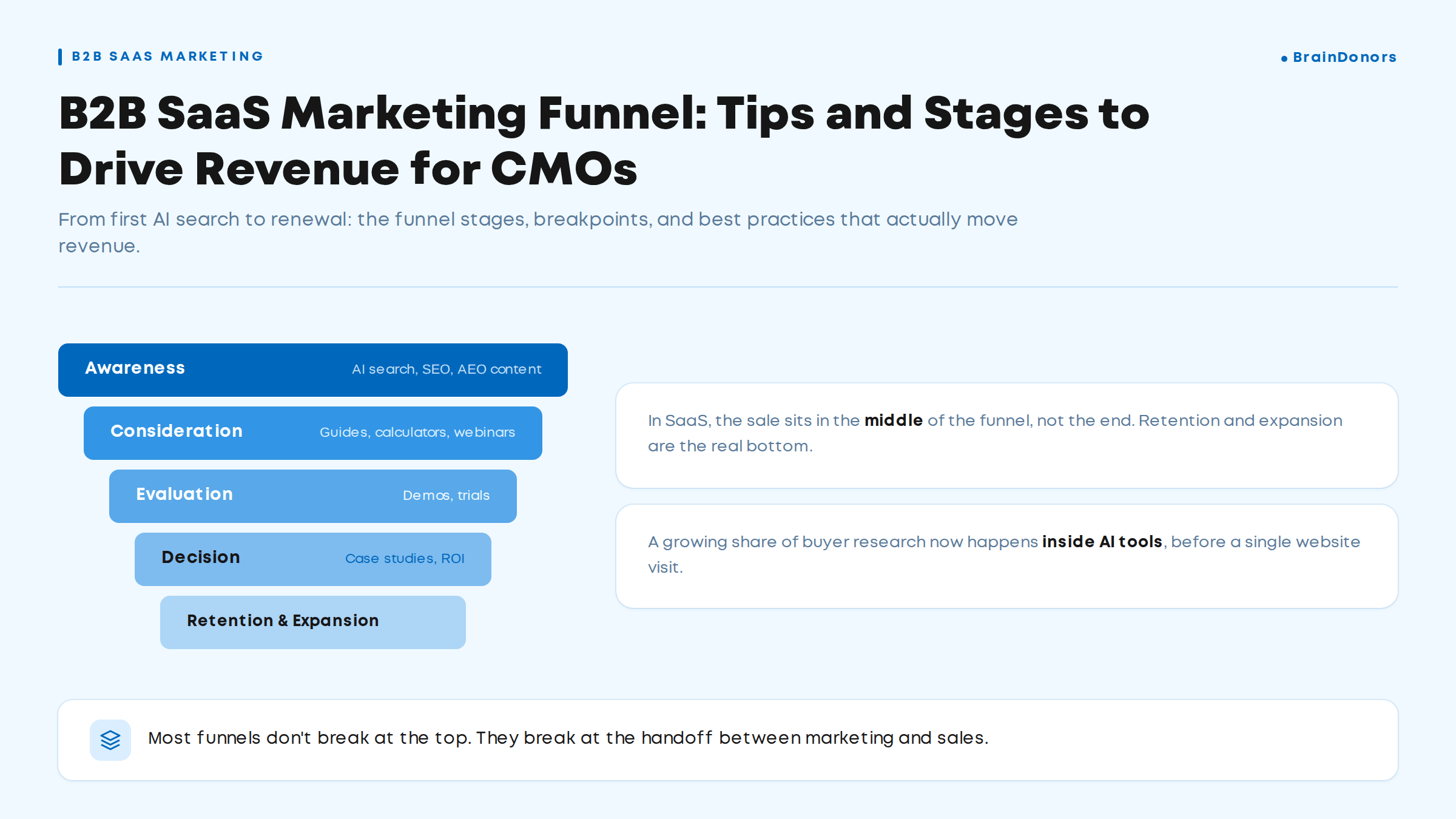
A B2B SaaS marketing funnel is the process that turns potential buyers into long term customers. It guides prospects from the moment they recognize a problem through evaluation, purchase, onboarding, renewal, and expansion.
Unlike a traditional funnel, success does not end with the first sale because recurring revenue depends on keeping customers engaged and growing their accounts over time.
For today's CMOs, building an effective B2B SaaS marketing funnel is more challenging than ever. Buyers compare vendors through Google, AI search, review platforms, and peer recommendations long before they speak with sales.
That means your funnel must attract the right audience, answer critical buying questions, and create trust across every stage of the journey, even before someone visits your website.
In this guide, you'll learn the key B2B SaaS marketing funnel stages, how AI is changing buyer behavior, where funnels lose qualified opportunities, and the practical strategies leading SaaS companies use to generate more revenue from both new and existing customers.

A traditional marketing funnel ends at the sale. A B2B SaaS marketing funnel treats the sale as the middle of the story, not the end of it.
Once someone becomes a customer, you still need them to activate, renew, and ideally buy more from you. Miss that part and your funnel is only doing half its job, no matter how many demos it books.
This changes almost everything about how a CMO should plan. The budget can't just chase new logos, because a renewal lost is often more expensive to replace than a new customer is to acquire.
Content can't stop at "why buy us," because a large share of your funnel's job now happens after the contract is signed, inside the product, in onboarding emails, and in renewal conversations your marketing team should still be shaping.
It also means more people touch the decision than in most B2C or even traditional B2B buying.
Gartner research shows that modern B2B buying journeys involve multiple stakeholders, non-linear research paths, and a growing mix of digital and human interactions before a purchase decision is made.
Your funnel needs to serve all of them, not just the champion who eventually books the demo.
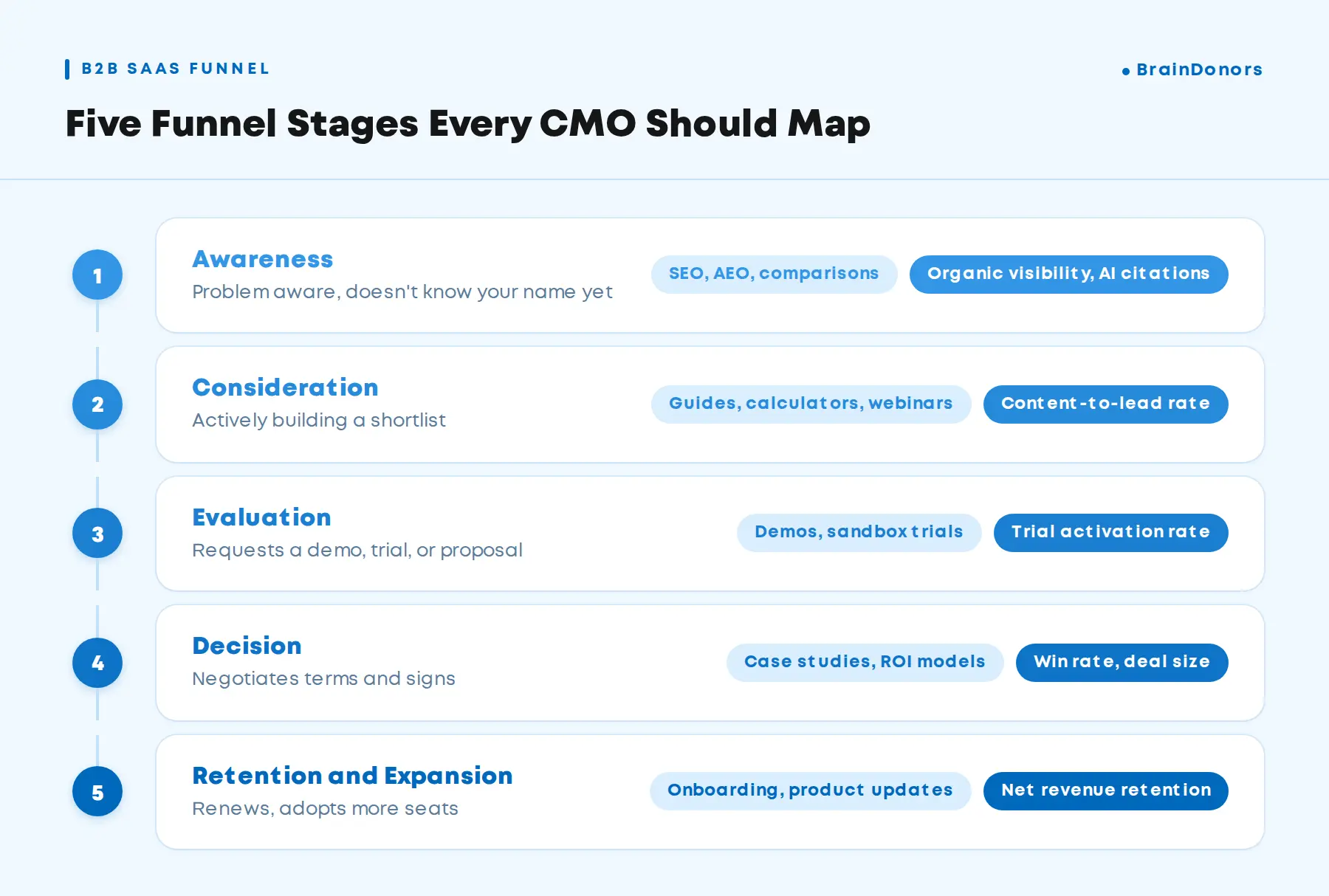
Strip away the jargon and a B2B SaaS marketing funnel has five stages that matter for revenue planning. Each one needs its own content, its own metrics, and its own owner, even if marketing and sales share responsibility for a few of them.
Notice that awareness and retention live at opposite ends, yet in a lot of SaaS companies they're owned by completely different teams that never talk to each other.
That gap is where a huge amount of preventable churn actually starts, not in the product, but in the silence between the team that won the customer and the team keeping them.
The awareness stage of your B2B SaaS lead generation funnel doesn't look like it did two years ago.
Forrester's 2026 Buyers' Journey Survey, which covered roughly 18,000 global business buyers, found that 94 percent had used an AI tool like ChatGPT, Gemini, or Perplexity during their most recent purchase process. A large share of them compare vendors directly inside those tools before visiting a single website.
We saw this play out directly with one of our own SaaS demand generation clients. Their sales team closed a deal where the buyer never visited the website before booking a call.
Zero pageviews, zero form fills, nothing in the CRM to attribute the lead to. What actually happened, confirmed later in the sales conversation, is that the buyer ran three separate comparison prompts through ChatGPT while shortlisting vendors in the category.
Our client's product came up by name in that comparison, with specifics pulled straight from a piece of content we'd built around exactly that use case.
The lead entered as a demo request with no visible funnel history at all, because the entire top of the funnel had happened somewhere marketing analytics couldn't see it.
That's not a fluke case, it's the new normal for a growing share of demand gen. This is the "dark funnel" problem CMOs are starting to hear about: a real, meaningful part of the buyer journey that happens inside AI tools and leaves no trackable trail in your usual analytics.
If your content isn't structured to be cited by those tools, whether that's clear comparison data, specific numbers, or direct answers to buyer questions, you simply don't exist in a growing number of these conversations.
Answer engine optimization, or AEO, is how you fix that. It means writing content that answer engines can extract and quote cleanly: direct answers near the top, specific numbers instead of vague claims, and structured data that machines can parse as easily as humans can read it.
We cover the mechanics of this in our SEO services built for both Google rankings and AI visibility, and it's become one of the fastest-growing parts of any serious B2B demand generation strategy we run for clients right now.
One of our SaaS accounts saw a 12x increase in organic visibility after we restructured their content around this exact approach, which you can read more about in our SEO and AEO case study.

Cold outbound is getting harder every quarter. Response rates on non-personalized cold email have fallen below 2 percent industry-wide, because AI-written outreach is now so common that buyers filter it out on instinct.
A B2B inbound marketing funnel, where the buyer finds you instead of the other way around, is no longer a nice-to-have channel next to outbound. For a lot of SaaS companies, it's becoming the only channel that still reliably works at scale.
Building one properly means mapping content to the actual questions a buyer asks at each stage, not just publishing whatever keyword tool spits out.
A buyer in the awareness stage is asking "what's causing this problem," someone in consideration is asking "which type of solution fits my situation," and someone in evaluation is asking "why you and not the other two names on my shortlist."
Each of those needs a genuinely different piece of content, written for a different level of knowledge.
The other piece most companies get wrong is treating inbound content as a one-off publishing task instead of a connected system.
A blog post that ranks well but sits disconnected from your CRM, your lead scoring, and your sales team's talk tracks is just traffic, not pipeline.
Real B2B content marketing connects directly into your marketing automation so a lead's content history actually informs how sales approaches the first call, and a proper HubSpot setup is usually what makes that connection possible without your team manually stitching spreadsheets together every week.
Ask most CMOs where their funnel underperforms and they'll point to the top: not enough traffic, not enough leads. In practice, the break usually happens somewhere much less visible.
The most common failure point is the handoff between marketing and sales. Marketing calls a lead qualified because they downloaded a guide and fit the target company size. Sales calls that same lead a waste of time because there's no real buying intent behind it.
Both teams are right by their own definition, and that disagreement quietly kills a huge share of otherwise good leads before anyone even notices they're gone.
The fix isn't more leads, it's one shared definition of what actually counts as sales-ready, agreed on by both teams and revisited every quarter as your product and market shift.
A lead scoring model that both marketing and sales built together, sitting inside one CRM both teams actually look at, closes this gap faster than almost anything else you can do to the top of the funnel.
A second common break is attribution that only tells half the story. If your reporting can only see last-click, you'll systematically overvalue late-funnel channels like branded search and undervalue the content that actually built the buyer's shortlist three months earlier.
That's exactly the kind of gap that leaves you unable to defend budget in a board meeting, because you're arguing from a dataset that's missing a third of the story.
Fixing both of these is less about adding more tactics and more about treating B2B demand generation as one connected system, where marketing, sales, and reporting are solving the same problem instead of three separate ones.
These are the practices that actually move revenue, not vanity metrics. None of them are exciting, and that's exactly why most companies skip them.
If your team is still figuring out which of these to tackle first, a full B2B SaaS marketing strategy built around your specific stage of growth usually surfaces the highest-leverage fix faster than trying to run all six at once.
Board members don't care about traffic. They care about three things: how much it costs to get a customer, how long that customer stays, and how confident you are in the number you're reporting.
Customer acquisition cost only means something next to customer lifetime value. A CAC of five thousand dollars sounds expensive until you know the customer stays for four years and expands their contract twice. Report these two numbers together, every time, or the first one will always look worse than it actually is.
Net revenue retention is the number that separates SaaS reporting from every other industry's funnel metrics. It tells you whether your existing customer base is growing or shrinking in revenue terms, independent of new sales entirely.
A company can hit every new logo target on the board deck and still be losing ground if net revenue retention is dropping.
Finally, be honest about attribution confidence. A dashboard that pretends to know exactly where every dollar of pipeline came from is usually hiding gaps, not solving them. It's more credible, and more useful, to report a range with your confidence level attached than to present a single false-precision number that falls apart under one follow-up question.
One of our SaaS clients, ImagenAI, went through exactly this kind of maturity shift when they expanded from a product-led model into a dedicated sales-led channel.
Getting the RevOps and reporting infrastructure right was what let their new sales team hit its first-year targets in full, which we cover in our PLG to SLG growth case study.

A B2B SaaS marketing funnel isn't a diagram you build once and hang on the wall. It's a living system that has to account for a buying committee of eight people, a growing share of research happening inside AI tools you can't fully see, and a revenue model where the sale is the middle of the relationship, not the end of it.
The CMOs who win this year aren't the ones with the biggest budgets. They're the ones who fixed the boring stuff first: one lead definition both teams agree on, content built to answer real buyer questions wherever those buyers are asking them, and a dashboard everyone actually trusts.
Get those three right and the rest of the funnel gets a lot easier to defend, in the boardroom and everywhere else.
If you want a second pair of eyes on where your own funnel is leaking, our team maps this out with SaaS companies every week, and it usually takes one working session to find the highest-impact fix.
Most B2B SaaS sales cycles run between one and six months, depending on contract size and the number of people in the buying committee. Enterprise deals with multiple stakeholders regularly stretch past six months, while self-serve or lower-priced SaaS products can close in a matter of weeks. AI-assisted research is starting to compress the earlier part of this cycle, since buyers arrive at the evaluation stage already having done comparison work on their own.
A marketing funnel tracks a buyer from first awareness through becoming a qualified lead, while a sales funnel picks up from that qualified lead through to a closed deal. In practice the two overlap in the middle, which is exactly why a shared lead definition between both teams matters so much. Companies that treat these as one continuous funnel, rather than two separate ones handed off at an arbitrary point, tend to report cleaner pipeline numbers.
Yes, though the funnel looks different. In a product-led motion, the free trial or freemium signup often sits near the top of the funnel instead of near the bottom, and the product itself becomes a major driver of consideration and conversion. Companies that later add a sales-led channel alongside PLG, which is increasingly common as SaaS businesses move upmarket, need both funnels mapped clearly so the two motions don't compete for the same leads.
At minimum, a CRM and marketing automation platform that both marketing and sales use daily, a way to track content performance by buyer stage, and some form of multi-touch attribution reporting. HubSpot is the most common single platform that covers the CRM and automation pieces together for mid-market SaaS companies, which is why it shows up so often in funnel rebuilds. Beyond the core stack, AI visibility tracking is quickly becoming a standard addition given how much research now happens inside chat tools.
Start by checking whether marketing and sales are using the same definition of a qualified lead, since a mismatch here is the single most common cause of high lead volume with low close rates. Next, look at whether your content actually addresses the objections that come up on sales calls, since a funnel that builds awareness but never answers the buyer's real hesitations will produce leads that stall in evaluation. Finally, review your lead scoring model against actual closed-won data from the last two quarters rather than assumptions made when the model was first built.
