Contributors

B2B SEO hasn't died. But the version most teams are running isn't keeping up.
Google's AI Overviews now appear above organic results and buyers research vendors in ChatGPT before they run a single search. So the old approach of "publish content, build links, wait for traffic"... well, it produces rankings that don't convert.
We’ve worked with 100+ B2B companies on rebuilding their B2B SEO strategy from the ground up: keyword tiers mapped to real buying intent, content built to convert, and attribution that shows leadership exactly what organic contributes to pipeline.
So here's the full approach, including what we measure and why it still outperforms almost every other channel.
A B2B SEO strategy is a structured plan for getting your website in front of the decision-makers who are actively searching for solutions like yours.
It's fundamentally different from B2C because the buyer is rarely one person making an independent decision.
And here's the key distinction: when you're selling to businesses, you're not convincing one person to click "buy now." You're showing up for a committee of people (a procurement lead, a technical evaluator, a budget holder) who are all doing their own research, at different stages, over the course of weeks or even months.
And that's a completely different problem than standard SEO, which is why B2B companies often need a more specialized SEO approach built around longer sales cycles and multiple decision-makers
So every piece of content has to earn its place by speaking to a real moment in that buying journey, not just capturing impressions.
And the stakes are high. Organic search drives 44.6% of all B2B revenue, more than any other single digital channel.
But that revenue doesn't come from traffic volume alone. It comes from the right traffic landing on the right content, on a site that's actually built to convert.
So that's the what and the why. Now let's look at what a B2B SEO strategy actually needs to be made of to deliver on that promise.
A complete B2B SEO strategy has four core components: keyword research and website architecture (designed around how buyers search at each funnel stage), technical readiness (making sure everything you build is actually indexable and fast), content production (human-written, E-E-A-T aligned, and built to convert), and CRM attribution (connecting leads back to the organic channel that generated them).
Here's what each one does and why it matters:
When all four work together, the results compound fast.
Here is an example:
For Nissha Europe, a B2B manufacturing client, rebuilding their entire SEO around proper architecture, technical foundations, and industry-specific content produced over 500% growth in organic traffic and a 200%+ improvement in average session duration.
Now with the components mapped out, the next thing worth understanding is how this fits into the bigger picture of a full B2B marketing strategy, because SEO in isolation rarely delivers what teams expect from it.
B2B SEO is the organic engine of B2B demand generation: it sits in the Visibility layer of a full-funnel strategy, creating the first touchpoint with buyers who are already in research mode.
But for SEO to work as a pipeline channel rather than just a traffic source, it needs two more layers running alongside it: Credibility content (case studies, comparisons, and frameworks that build trust) and Conversion infrastructure (lead magnets, demo paths, retargeting, and nurturing).
Without those layers, organic traffic flows in and quietly leaks back out without ever becoming a lead.
This is the core logic of our demand engine model, the framework we use with every B2B client we work with:
The key detail most teams miss is that these three systems run in parallel, not in sequence.
And we see it constantly. A company invests in SEO for six months, watches rankings improve, and then wonders why nothing is converting.
Almost always, it's because Systems 2 and 3 were never built alongside it. You can rank on page one for dozens of relevant keywords. But if there's nothing credible for that visitor to land on and no clear path to a next step, they leave just as quietly as they arrived.
But we know the more immediate question on most teams' minds is simpler and more urgent: why isn't our SEO generating leads?
B2B SEO drives leads when content is matched to buyer intent at the right funnel stage, not just optimised for search volume.
A buyer typing "best demand gen agency for B2B SaaS" is actively comparing vendors right now. But a buyer typing "what is demand generation" is still learning.
So both are valid searches, but only one of them should be your priority if the goal is pipeline.
TOFU content has its place: it builds topical authority and puts you in front of buyers early in their research. But top-of-funnel visibility is under more pressure than it used to be, and the path from TOFU traffic to pipeline is a long one.
On the other side, MOFU and BOFU are a different story. When someone is shortlisting vendors or evaluating whether a solution fits their specific situation, they need depth that a quick summary can't provide.
So they click, and far more importantly, they convert.
Intent sets the direction and content is the vehicle that takes you there. So the natural next question is: which content types actually do that job best?
The content types that convert best in B2B SEO target buyers who are in evaluation mode: service pages, solution pages, comparison pages, and use-case-specific landing pages.
These are the pages that match what buyers search for when they're 60-70% through a decision. Blog content (long-form articles) supports the strategy at the TOFU and upper MOFU level, but the commercial pages are often where pipeline actually comes from.
Here's how the content hierarchy works in practice:
One principle we come back to consistently: we always say your article is a product.
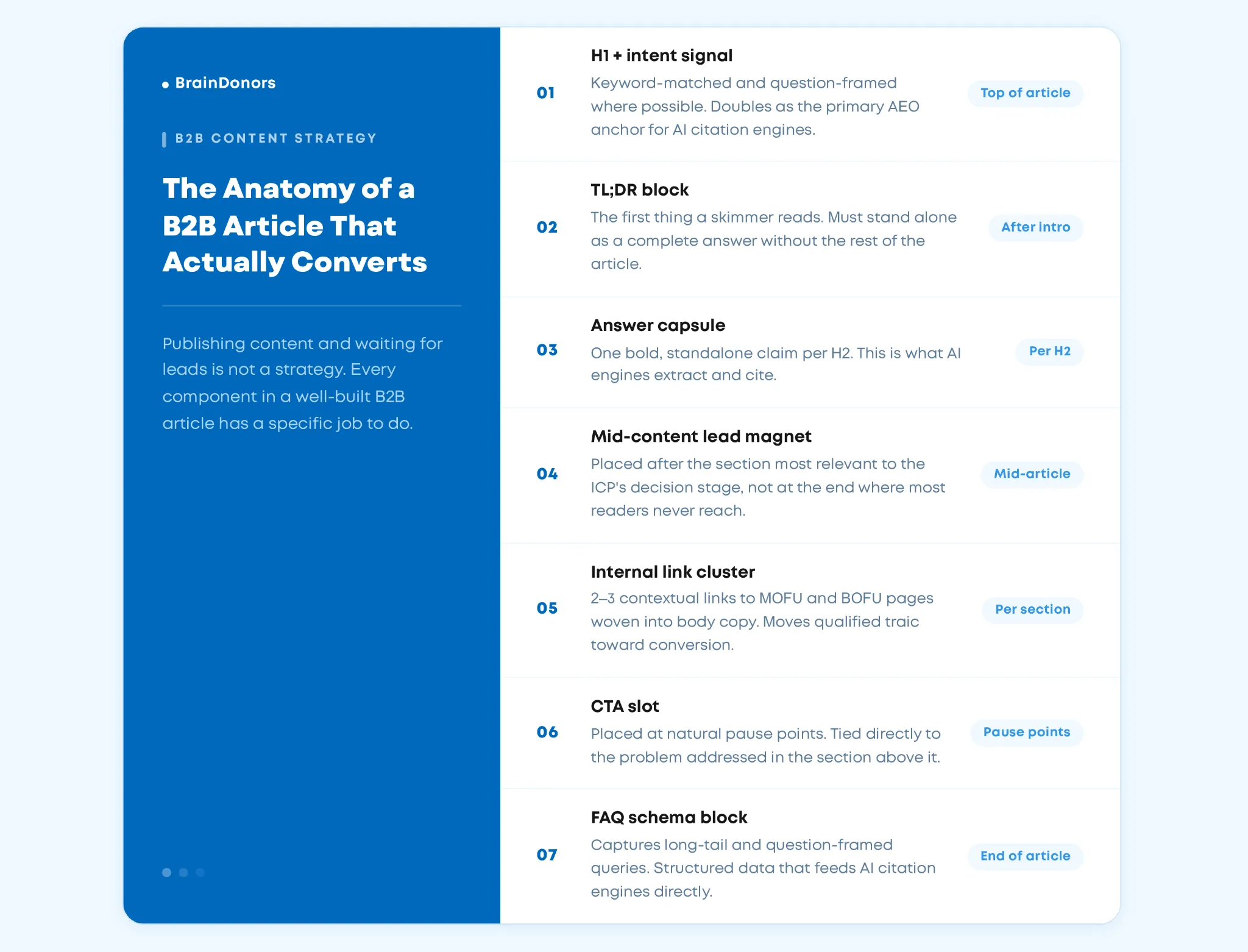
Publishing content and waiting for leads to appear is not a strategy. Every article needs lead magnets and conversion components built into the structure itself, so that when the right visitor arrives, there's a clear and relevant next step waiting for them.
Here is what a properly built B2B article actually contains:
One of the most effective formats for lead magnets? Custom calculators and estimation tools.
If someone is reading a comparison page, a well-placed calculator that estimates how much they could save, or what ROI they might expect, is a natural and non-pushy way to capture the lead at exactly the right moment in their research. These tools rarely rank directly (though in some niches they do), but they convert visitors who came in through the content sitting around them.
The Hypergen case study is probably our clearest example of the content pivot making a measurable difference. Their existing B2B content was educational and broad, which built general traffic but wasn't attracting buyers in evaluation mode.
When we restructured around intent-mapped MOFU formats and built proper conversion components into the content itself, four months later: 12x growth in impressions, 42% more clicks, and leads from organic quadrupled.
And no, not by publishing more. By publishing smarter content with a clear job to do.

But knowing what content to create is the "what." Having a systematic plan for building it in the right order and proving it works is the "how."
So here's how we actually do that.
Building a B2B SEO plan that reliably connects to pipeline follows five sequential steps: designing the website architecture and keyword strategy, making the site technically ready, producing content consistently, setting up CRM tracking and attribution, and building a nurturing system to activate the leads you generate.
Let’s cover them one by one.
🗺️ Build the structure before you build the content.
🔧 Make sure everything you build is actually indexable.
✍️ Your article is a product, so treat it like one.
📊 Make SEO's contribution visible to leadership.
Every organic lead needs to flow into a CRM where it can be tracked and eventually tied to closed revenue.
We use HubSpot for pipeline attribution, but the principles apply to any setup.

💬 Don't let organic leads go cold before sales ever sees them.
Once the plan is built, the next question is how to know if it's working. And not just in an "impressions are up" kind of way, but in a "here's the pipeline we can attribute to organic" kind of way.
So let’s talk KPIs.
The most important B2B SEO KPIs split into two layers: front-end metrics (what's happening in search and on your site) and back-end metrics (what those visits are actually producing in pipeline).
And here's the full reporting framework across both layers:
A few things worth calling out explicitly in how you read this table:
Branded impressions convert higher because the buyer already knows who you are. And non-branded impressions are the growth signal: they show you how effectively your content is reaching buyers who haven't found you yet.
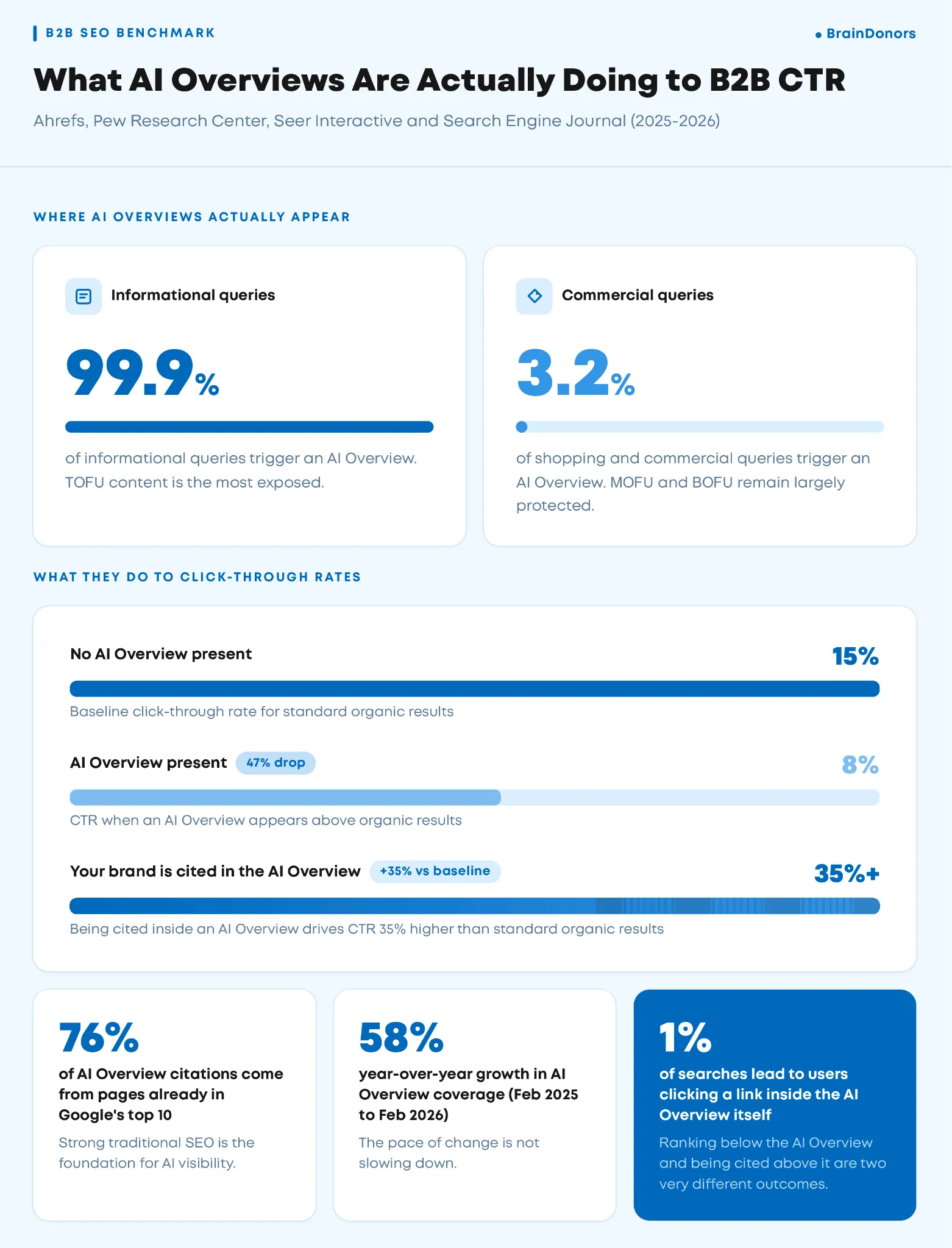
AI Overviews are changing click behaviour across every category. So if impressions are growing and CTR is dipping slightly, that's a normal pattern right now. The trend across several months matters far more than any single month's number.
Even a first-position organic ranking sits below a Google AI Overview. So monitor your AI visibility alongside your standard position data, because those two numbers together tell the real story of where you're actually showing up on the page.
And speaking of AI search…it's probably the question we hear most from B2B marketers right now.
Is SEO even still worth it? Let's address it directly.
Yes, B2B SEO still works and it remains one of the primary channels driving real business results. What's changed is not whether SEO matters, but how it needs to be executed.
AI is reshaping how people search and how results surface, and the companies that understand that shift will have a meaningful competitive advantage over the ones still running a pre-AI playbook.
Here's what has genuinely changed:
The numbers behind that shift are worth seeing clearly.
And here's what hasn't changed, and won't change soon:
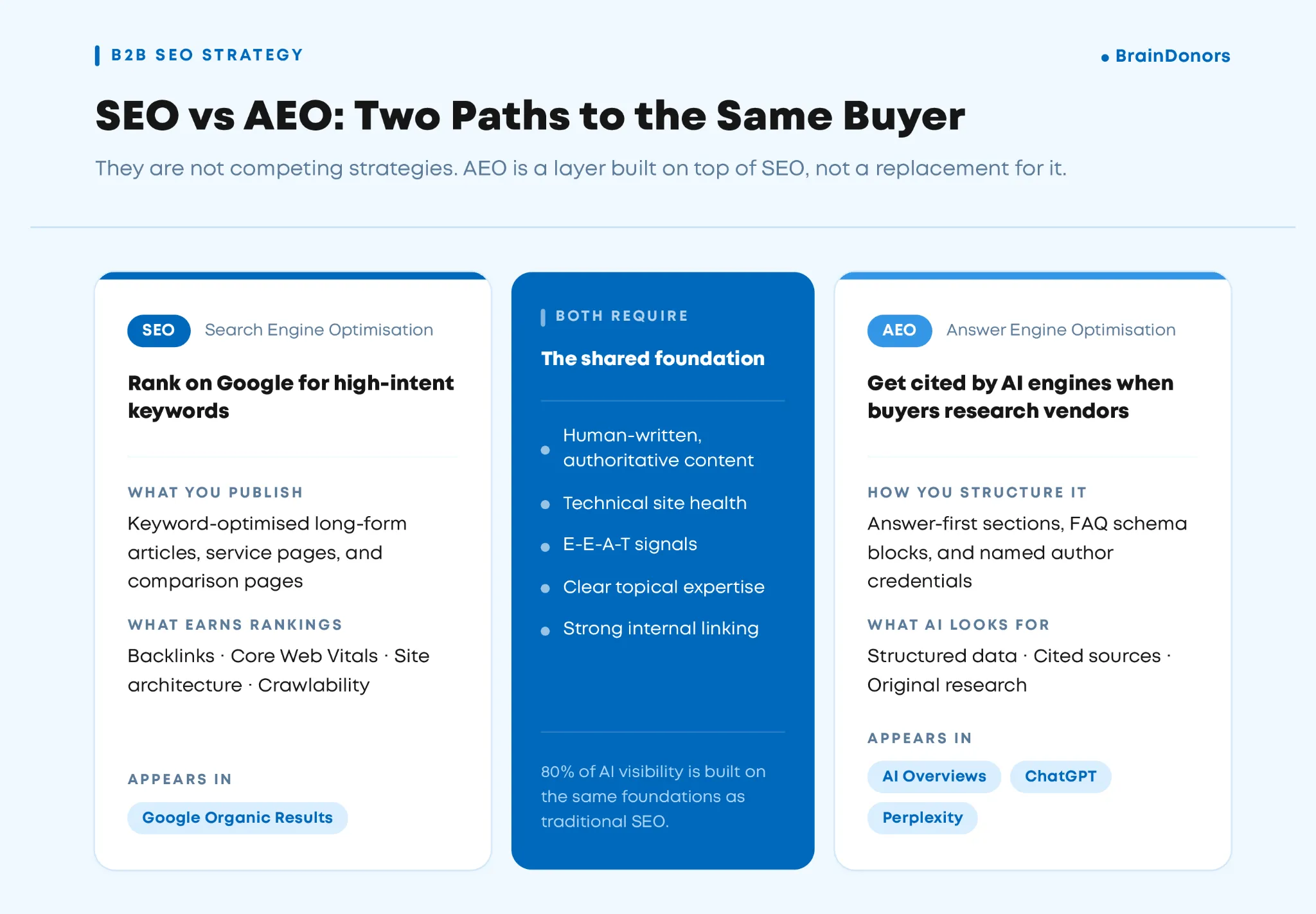
What this means practically: keep doing everything a strong SEO strategy requires, and layer in the optimisation steps that specifically improve AI visibility (answer-first section structure, FAQ schema, named author credentials, and cited sources).
Think of it this way:
So no, SEO is not going to die.
The most visible positions on the results page are becoming more competitive and more valuable at the same time. And the companies building strong foundations now are the ones who will hold those positions as AI continue to expand.
That’s why we also provide AEO (Answer Engine Optimisation) services alongside our core SEO work, because the two genuinely need to be built together.
One principle runs through everything we covered: a B2B SEO strategy compounds when it's built backward from how your buyer makes decisions, not forward from what ranks.
But unfortunately most teams get this backwards. They chase keyword volume, publish what's easiest, and wonder why pipeline isn't moving.
What's actually missing is the full system: intent-mapped architecture, technical foundations, content that converts, and attribution that proves it.
So that's exactly what we build. And the results don't lie: clients who were scratching their heads about organic at month three are protecting it as their strongest acquisition channel at month twelve. 📈
If you want to see what that looks like for your business specifically, let's figure it out together.
Both drive pipeline, but on different timelines. Paid search delivers results faster; SEO compounds over 6-12 months with consistently lower CAC long-term. The best B2B strategies we build run both in parallel rather than treating it as an either-or decision.
Yes, and it's one of the most cost-effective first moves in a new region. Localised content matched to local search behaviour, regional backlinks, and correct hreflang setup help your brand reach the right buyers before committing to paid media spend.
SEO feeds the whole system. Organic content drives visitors that retargeting can re-engage on LinkedIn. High-performing articles supply material for email nurture sequences. And your CRM tracks which leads came from organic and what they turned into in pipeline.
It improves significantly. As MOFU and BOFU content earns authority, organic traffic shifts toward buyers in active evaluation mode. Most clients we work with report shorter sales cycles and higher close rates on organic-sourced leads by the 9-12 month mark.It improves significantly. As MOFU and BOFU content earns authority, organic traffic shifts toward buyers in active evaluation mode. Most clients we work with report shorter sales cycles and higher close rates on organic-sourced leads by the 9-12 month mark.
The five-step framework stays consistent, but execution varies by buyer behaviour. SaaS buyers need comparison pages. Manufacturers need technical spec content. Professional services firms need thought leadership that proves expertise. So the content types change, but the strategy logic does not.