Contributors


Inbound marketing is the practice of earning attention instead of buying it. For a SaaS company, that usually means attracting the right buyers through content, SEO, and email, rather than chasing them down with cold outbound or paid ads alone.
Done well, SaaS inbound marketing builds trust before a prospect ever talks to sales, which shortens the sales cycle and makes every conversation easier. Below, we'll get into where that trust actually breaks down, and walk through the 90 day approach we use to rebuild it with clients.
Most SaaS companies we talk to already have the basics covered. They publish blog content for SEO, post regularly on LinkedIn, and run an email nurture sequence once someone converts. None of that is wrong, and these channels can still work.
They're just not enough on their own anymore, because almost every competitor in the space is doing the exact same thing.
Here's the pattern we keep running into with the SaaS inbound marketing clients we work with:
● Traffic is up across the board, often significantly.
● Content output has never been higher.
● Pipeline stays flat, quarter after quarter.
● Nobody on the marketing team can fully explain the gap.
We've sat in enough of these conversations to know it's rarely a lack of effort. It's almost always a lack of connection between what marketing is doing and what sales actually needs.
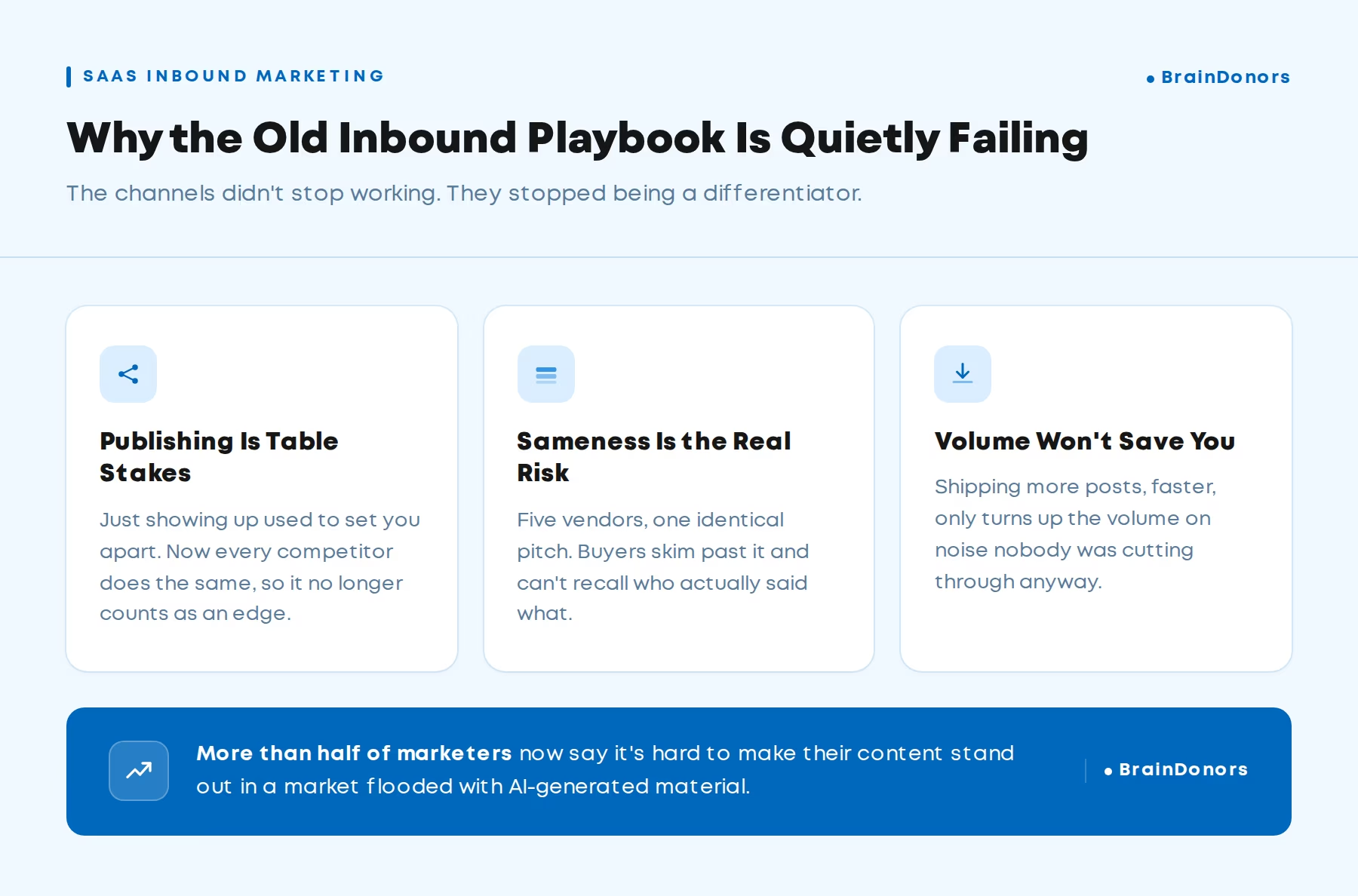
Five years ago, publishing consistently was a genuine advantage, because most SaaS companies weren't doing it yet. If you wrote helpful content and showed up on LinkedIn regularly, you stood out from the crowd almost by default.
That advantage has mostly disappeared. Every SaaS company in your category now runs a blog, every founder posts on LinkedIn, and every product has a nurture sequence and a webinar series to match. The channels themselves didn't stop working. They simply stopped being a differentiator, because everyone is using them the same way.
When an entire category runs the same five channels with the same tactics, the result is sameness. Buyers land on content from five different vendors that reads almost identically, skim through it, maybe download a guide, and move on without remembering who wrote what. Nothing about that experience tells them which vendor actually understands their problem.
Call it what it actually is: a saturation problem, not a channel problem. Publishing more content won't fix it, no matter how good that content is. HubSpot's 2026 State of Marketing research backs this up: more than half of marketers surveyed said they now struggle to make their content stand out in a market flooded with AI-generated material.
It's one of the first things we point out to SaaS clients who come to us convinced their SaaS inbound marketing simply needs "more." Usually, they don't need more. They need the inbound they already have to work harder for them.

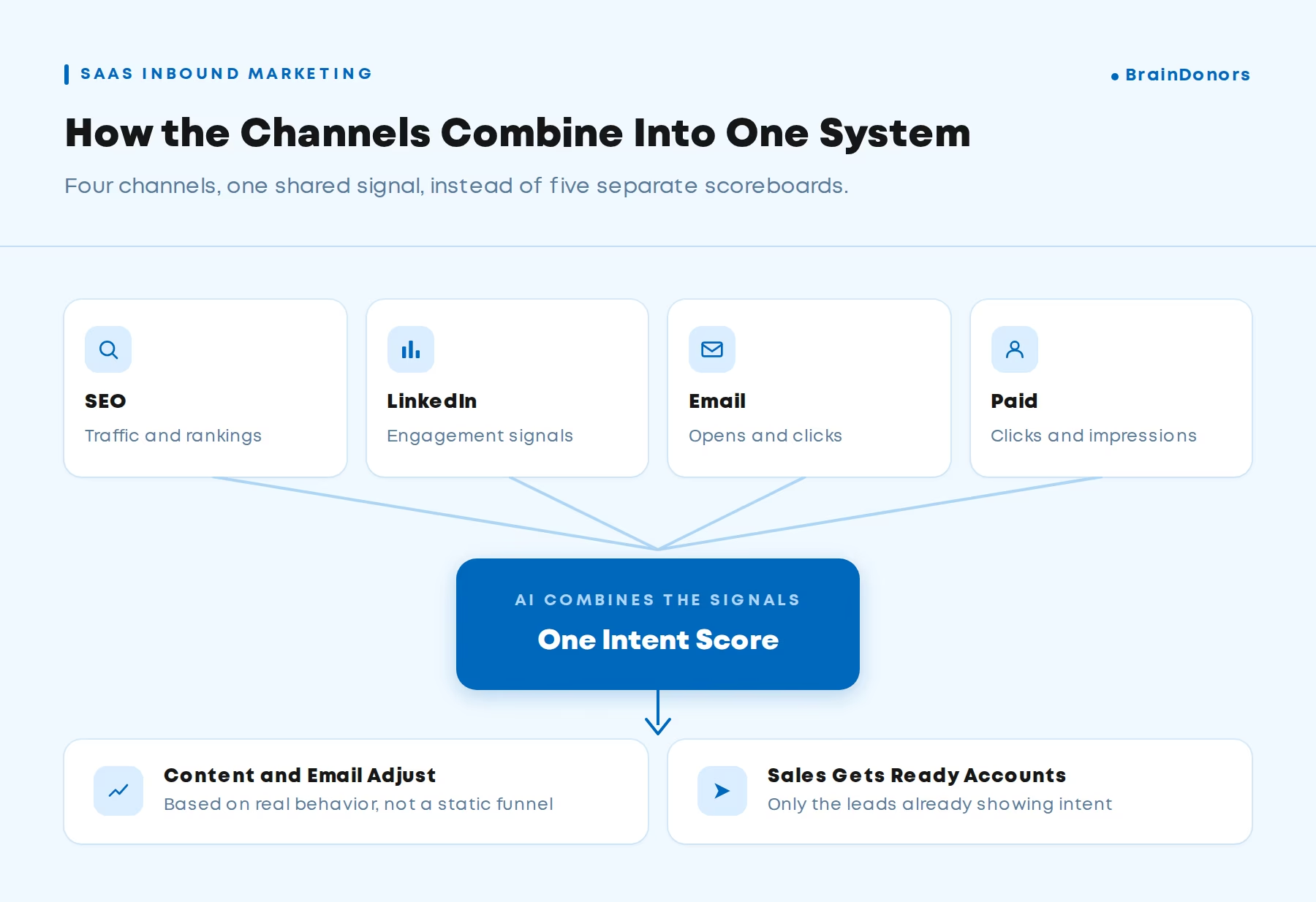
Here's what usually happens inside a SaaS marketing team. Each channel has its own owner, its own dashboard, and its own definition of a good week:
The problem is that none of those metrics tell you who is actually close to buying.
A visitor can read three blog posts, open five emails, and follow your CEO on LinkedIn, and still show up in your reporting as a complete stranger, because each channel only sees a fragment of that behavior.
So content marketing keeps producing more of whatever looks good on its own dashboard, while sales keeps saying the leads coming through aren't ready to talk.
This is exactly why traffic and pipeline drift apart over time. You're optimizing five separate channels for five separate goals, and revenue isn't one of them.
New expert predictions point to the same root cause: when marketing teams plan each channel independently, buyers end up on the receiving end of overlapping messages and inconsistent journeys, not a coordinated experience.

Most of what gets labeled "AI in marketing" right now is really just AI writing blog posts faster. That's probably the least useful place to put it, since faster content production doesn't solve a saturation problem, and in a lot of cases it makes it worse.
The role AI should actually play in SaaS inbound marketing is different. Forget content generation for a second. What it should actually be doing is connecting everything your channels are already collecting into one clear signal: who is showing real buying intent, right now, across every touchpoint you have. In practice, this means AI is doing a few specific jobs at once:
● Pulling behavioral data from your website, content, email, and ad interactions
● Combining that data into a single intent score per account or contact
● Flagging which accounts are ready for sales, and which still need nurturing
● Adjusting what each visitor sees next, based on where they actually are in the journey
Instead of five channels reporting five disconnected numbers, you end up with one answer to the only question that actually matters, which is whether this person is getting closer to a buying decision. This matters even more given how buyers actually research today.
Recent survey of B2B buyers found that the average buyer pulls from around seven different information sources before making a decision, and a large share of them now use generative AI somewhere in that process. If your channels can't piece that fragmented behavior back together, you're missing most of the picture.
Once that score exists, AI can also personalize what each visitor sees next. Someone who has already read your pricing page and a comparison article shouldn't receive the same generic newsletter as someone who landed on a glossary post once and never came back.
The content, your email marketing sequence, and even your LinkedIn retargeting can all adjust based on where someone genuinely is in their journey, instead of where a static funnel assumes they should be.
And honestly, that's where most of our AI conversations with clients end up going. Not "which tool should we buy," but "how do we get our existing channels talking to each other." AI's job here isn't to produce more content. It's to make five disconnected channels behave like one system.
We've seen this play out directly. When we built a dedicated AEO strategy for Wörwag Pharma, a healthcare brand competing in a heavily regulated, high-scrutiny category, they went from having no presence in AI-generated answers to the #1 brand position on their key topics, with a 40% share of voice in category-relevant AI conversations.
Different industry than SaaS, but the mechanism is the same: brands that show up inside AI-generated answers now win visibility that traditional rankings alone can't buy them.
Once channels are unified around a single intent signal, SaaS inbound marketing starts to compound instead of competing internally for attention.
Sales starts receiving a different kind of lead as a result. Instead of "downloaded a whitepaper once," it becomes something closer to "read three bottom of funnel articles, opened the pricing page twice, and engaged with a comparison post this week." That's a conversation a sales rep can actually work with.
None of this requires adding new channels. It just requires the channels you already run to stop operating like separate businesses.
Before you change anything, it helps to see exactly where you stand today. Ask yourself these questions honestly:
If most of these point to gaps, you're not alone. Honestly, this is close to the exact starting point we see with almost every SaaS company before we begin working together, and it's rarely a sign that the marketing team is doing anything wrong. It's just a sign that nobody has connected the dots yet.
One more thing: you don't need to fix all four gaps before you start. Pick the one costing you the most leads right now, usually the sales context gap, and start there.
We don't believe in rebuilding a SaaS company's entire marketing stack overnight, because change like this needs to happen in stages, and each stage needs to prove itself before the next one begins. Here's the framework we typically follow, laid out across three 30 day phases.
The first month is about visibility, not output. Before adding anything new, we map every channel currently in play and connect the data they're producing into one shared place.
In practice, this usually means tightening up tracking, cleaning up how leads are tagged, and building a shared view of account activity across content, email, and paid.
By day 30, you should be able to pull up any lead and see their full history across channels, not just the last form they happened to fill out. Most teams are genuinely surprised by how much behavioral data they were already collecting and simply never using.
With unified data in place, this is where AI-assisted scoring comes into the process. We build an intent model that ranks accounts and contacts based on real signals pulled from every channel, not just one, and content and email sequences start adjusting automatically based on that score. A high intent visitor sees different content than someone still early in their research.
This phase is also where we tighten up the handoff to sales. Instead of routing every single form fill, we route the accounts that are actually showing intent, along with enough context for sales to use it immediately.
By the final phase, the system should be producing a noticeably different kind of lead. This is when we shift reporting away from traffic and engagement metrics and toward pipeline influenced and pipeline generated, broken down by channel.
We also close the loop back with sales to confirm the leads coming through are the ones actually closing, not just the ones that happen to look good in a dashboard.
By day 90, the question changes from "how much traffic did we get" to "how much pipeline did our channels actually produce, and which ones drove it."
Here's the framework at a glance:
This isn't a guaranteed formula, and results will vary depending on your company, market, and starting point. But the sequence itself, unify first, connect and personalize second, prove revenue third, is what consistently turns scattered channel activity into something sales can actually use.
It's the same underlying logic behind a properly built demand generation system, just applied specifically to how SaaS companies attract and nurture inbound buyers.
Prioritize connection over volume. Most SaaS companies already have enough channels running, and what they're missing is a way to see how those channels work together and which activity is actually driving buying intent. Start by unifying your data before you add new content or new channels on top of what already exists. This is the core of what makes SaaS inbound marketing actually produce pipeline instead of just traffic.
Start with your ideal customer's actual buying questions, not generic top of funnel topics that every competitor is already covering. Build content and pages that answer those questions at each stage, from early research through vendor comparison, and set up tracking from day one so you can see behavior across channels instead of isolated form fills. Add channels one at a time, and connect each new one to the same data before moving on to the next.
In most cases, it isn't the content itself. It's that your channels are being measured and managed separately, so nobody has visibility into which visitors are showing real buying signals across multiple touchpoints. Traffic without a way to identify intent just sits there and does nothing. Fixing the connection between channels usually matters more than producing even more content.
Fewer channels done well will beat five channels done halfway, almost every time. For most early stage SaaS teams, a focused set of bottom and middle funnel content, a tight email nurture, and one social channel where your buyers genuinely spend time will outperform a scattered five channel approach. The priority should be connecting whatever channels you already run, not adding more of them.
Stop measuring channels by traffic and engagement alone, and start tracking how many pipeline opportunities and closed deals can be traced back to inbound touchpoints. Tie your content and email data directly to your CRM so you can follow the actual path a closed deal took to get there. If you can't trace a deal back to the channels that influenced it along the way, you're measuring activity, not revenue.