Contributors

Plamen Polimenov
Team Lead PPC

Dilyana Sergieva
Team Lead Content & Copywriting
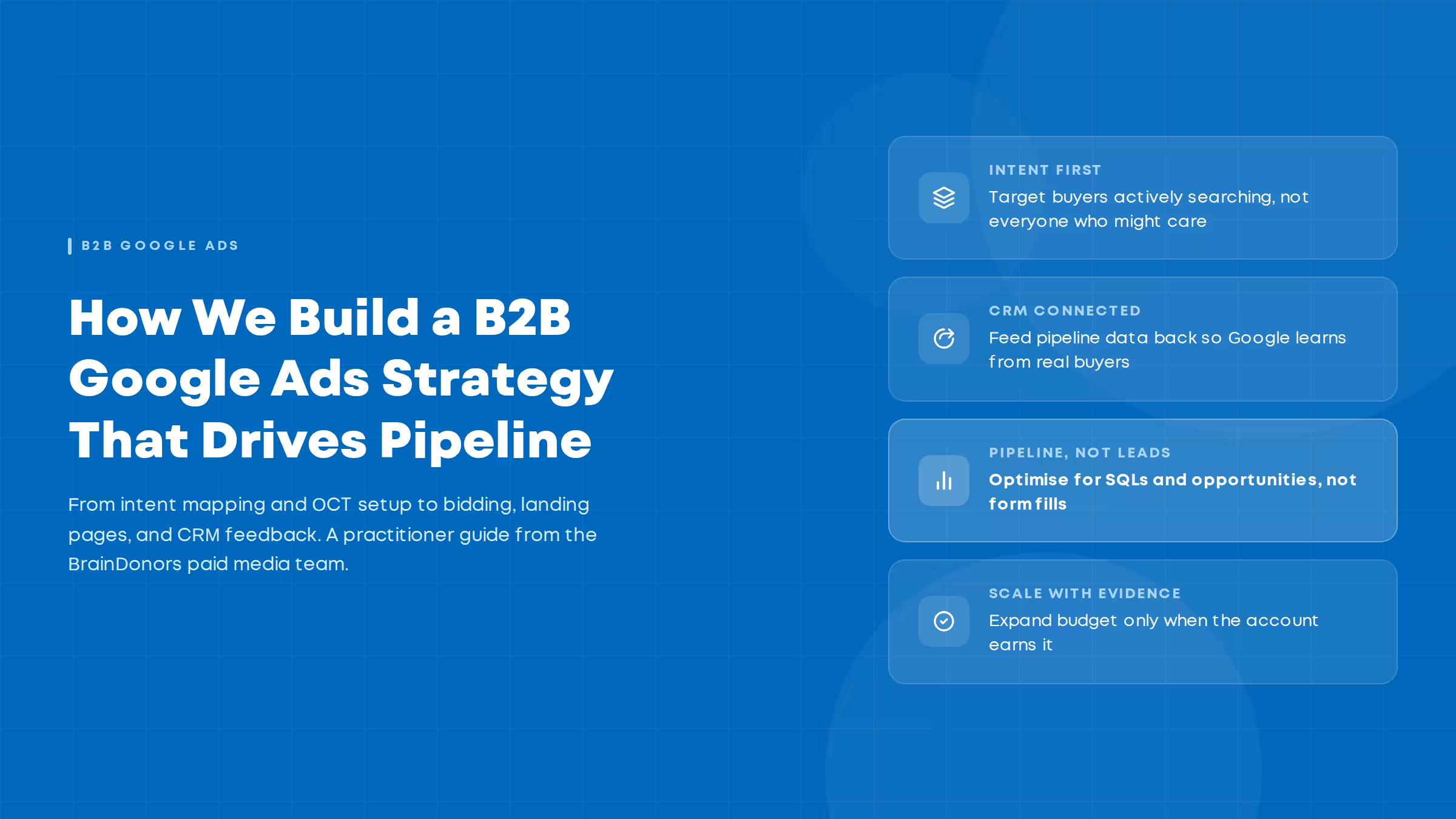
Google Ads has been one of the most valuable channels for lead gen for years. And it still holds that power. The ability to get in front of a buyer at the exact moment they are searching for a solution is something no other channel replicates as cleanly.
In B2B, however, turning that search into a qualified opportunity is rarely straightforward. Longer sales cycles, multiple decision-makers, niche audiences, and messy search intent mean the real challenge is not simply getting leads. It is knowing which leads are worth paying for.
A form fill does not always mean a sales opportunity. A low CPL does not always mean the campaign is healthy. And more conversions do not automatically mean more pipeline.
So, if you have been burning through budget, seeing conversions come in, and still hearing from sales that the leads are not the right fit, the problem is usually not Google Ads itself. It is the strategy behind it.
In this article, we’ll share our first-hand approach to building successful B2B Google Ads strategies that bring in leads your sales team actually wants to work with, without letting CAC spiral.
A lot of B2B Google Ads problems look like platform problems at first. Wrong keywords. Expensive clicks. Weak conversion rates. Sales rejecting leads. CAC getting a little too spicy.
But most of the time, the issue starts earlier.
After running 300+ B2B campaigns across SaaS, tech, healthcare, consulting, and services, we’ve seen the same pattern again and again: Google Ads performs best when the strategy is built around qualified pipeline, not just more conversions.
That is why our process starts before campaign setup and continues long after launch. Here’s how we build B2B Google Ads strategies that help turn search intent into opportunities.
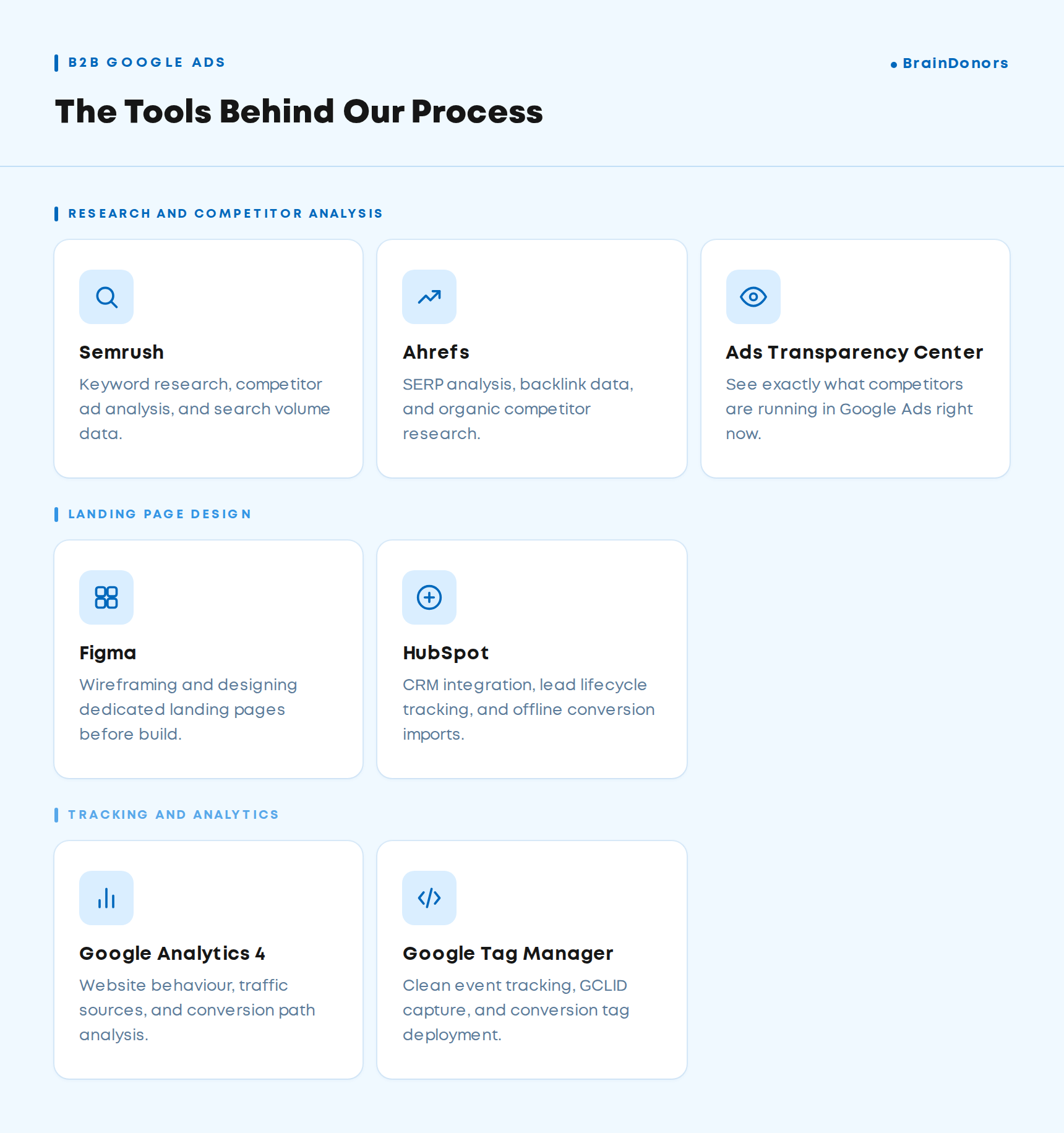
Before we open Keyword Planner, we look at the business.
That means understanding how your company makes money, which services or products you want to grow, which ones bring the strongest margins, who your best customers are, and how your current sales and marketing funnel works.
This usually includes:
This matters because your Google Ads strategy should be built around the parts of the business where paid search has the best chance of creating real commercial impact.
A service may be easy to advertise but hard to close. Another may have lower search volume but bring stronger-fit opportunities. The goal is to find where search demand, business priority, and revenue potential overlap.
Once we understand the business, we look at what is already in place.
That means auditing current campaigns to see what is working, what is wasting spend, where the gaps are, and which opportunities have not been tested yet.
We also review the quality of clicked search terms, because that often shows faster than any dashboard whether the account is attracting real buyers or just relevant-looking traffic.
From there, we do extended keyword research for the chosen services or products. But we do not stop at search volume. We look at the SERP, competitor ads, competitor positioning, and the types of pages ranking for those queries to understand whether the intent is actually worth paying for.
This also helps us decide where dedicated landing pages are needed.
If a keyword cluster has enough value and a clear enough intent, we map the page structure before launch, from wireframe and content to design and build.
The strategy needs to reflect how your company actually grows, not just how the category looks inside Google Ads.
Once we understand the business and the current setup, we define what a qualified lead actually means.
Because in B2B, “lead” is too broad to be useful on its own.
A student downloading a guide, a freelancer looking for inspiration, a company outside your target market, and a decision-maker actively looking for a partner can all become conversions inside Google Ads.
The platform may count them the same, but your sales team definitely will not.

That is why we define the criteria that separate a useful lead from a noisy one. This usually includes:
This definition shapes the keywords we choose, the audiences we exclude, the ad B2B copywriting we write, the landing pages we build, and the conversion data we feed back into Google Ads.
Not every relevant keyword needs the same budget, message, or landing page. Some searches show curiosity. Some show research. Some show comparison. Some show clear buying intent.
When intent is mapped properly, the strategy stops forcing every buyer into the same journey.
Once intent is clear, we structure campaigns around how buyers search, who we are trying to reach, and what each campaign is supposed to do.
This is where segmentation matters.
A common mistake is building campaigns only around services. One campaign for Google Ads. One campaign for B2B SEO. One campaign for marketing automation. Done.
That can work in simple accounts, but in B2B it usually gets messy fast. Different buyers search in different ways, respond to different messages, and need different proof before they are ready to talk to sales.
A stronger setup can segment campaigns by:
In the early stages, we usually stay close to the highest-intent demand first.
That means targeting people already searching for the product, service, category, or problem the business solves. They know something needs to change. Our job is to show up with the most relevant answer.
That can include:
Later, once the account has stronger data, we can test broader keywords, new match types, Performance Max, competitor campaigns, Demand Gen, YouTube, or AI Max campaigns.
But the order matters.
You capture existing demand first. Then you expand into demand generation strategies when the account has enough clean signals to support that growth.
B2B Google Ads is not only about finding the right people.
It is also about avoiding the wrong clicks.
This is where setup matters more than people like to admit. Default settings can quietly open the door to traffic that looks fine in the platform but does nothing for pipeline.
Before launching or scaling, we check things like:
In B2B, keyword strategy is not just about finding relevant terms. It is about understanding how easily relevant terms can drift into irrelevant intent.
A keyword may look commercially useful at first glance, but the actual search results can tell a different story. If the results are mostly definitions, tutorials, student resources, or general guides, the search is probably more informational than transactional.
That does not mean informational keywords are useless. It means they need the right role in the strategy.
For most new or under-optimized B2B accounts, we usually start tighter with exact and phrase match. Broad match can work, but usually only when the account has enough clean conversion data, strong negative keyword lists, and CRM feedback.
Otherwise, it can simply spend faster.
Common B2B exclusions often include terms like:
We use in-house negative keyword lists built for different industries, then add client-specific negatives based on the actual search terms coming through the account. That way, the structure is cleaner from the beginning and the budget has a better chance of going toward searches that can actually convert.
In B2B, the click usually starts with internal pressure: a target missed, a process breaking, a cost getting harder to justify, or a team looking for a better way to work. The ad needs to show that we understand that problem before asking them to take action.
That is why strong B2B ad copy is not just keyword insertion with a CTA at the end.
It should connect three things:
We also use assets like sitelinks, callouts, and structured snippets to give buyers more context before they click. In B2B, those small details can help qualify interest earlier and make the ad feel more specific to the buyer’s situation.
For example, “B2B Google Ads Agency” may match the keyword, but it does not say much.
A stronger message would speak to the real pain behind the search: poor lead quality, wasted budget, weak pipeline, messy tracking, or campaigns that sales does not trust.
This is also where ad copy can qualify before the click.
If the offer is built for SaaS teams, say that. If it is for high-value B2B sales cycles, say that. If the next step is a strategy call, make that clear.
The goal is not to attract everyone.
The goal is to make the right buyer feel, “Yes, this is about my problem.”
The click is not the finish line.
Once someone lands on the page, the experience has to continue the same message. The problem, promise, proof, and CTA should all match what the person searched for and what the ad said.
A buyer searching for a B2B Google Ads agency does not need a generic page explaining what Google Ads is. They need to know whether you understand their market, their sales cycle, their lead quality problem, and the kind of pipeline they are trying to build.
That is why we avoid sending high-intent traffic to generic pages whenever possible.
Different campaign types need different landing page logic:
For competitor campaigns, dedicated comparison pages are especially important. If someone is searching for an alternative to a known provider, the page needs to speak directly to that comparison instead of dropping them on a generic homepage.
A strong B2B landing page usually includes:
The psychology is simple: the page should answer the buyer’s next question, not just repeat the ad.
Not every conversion should carry the same weight.
A newsletter signup, a content download, a contact form, a demo request, an SQL, and a closed-won deal all tell you something different. If they are all treated as equal wins, the account learns from messy data.
That is why we separate primary and secondary conversions.
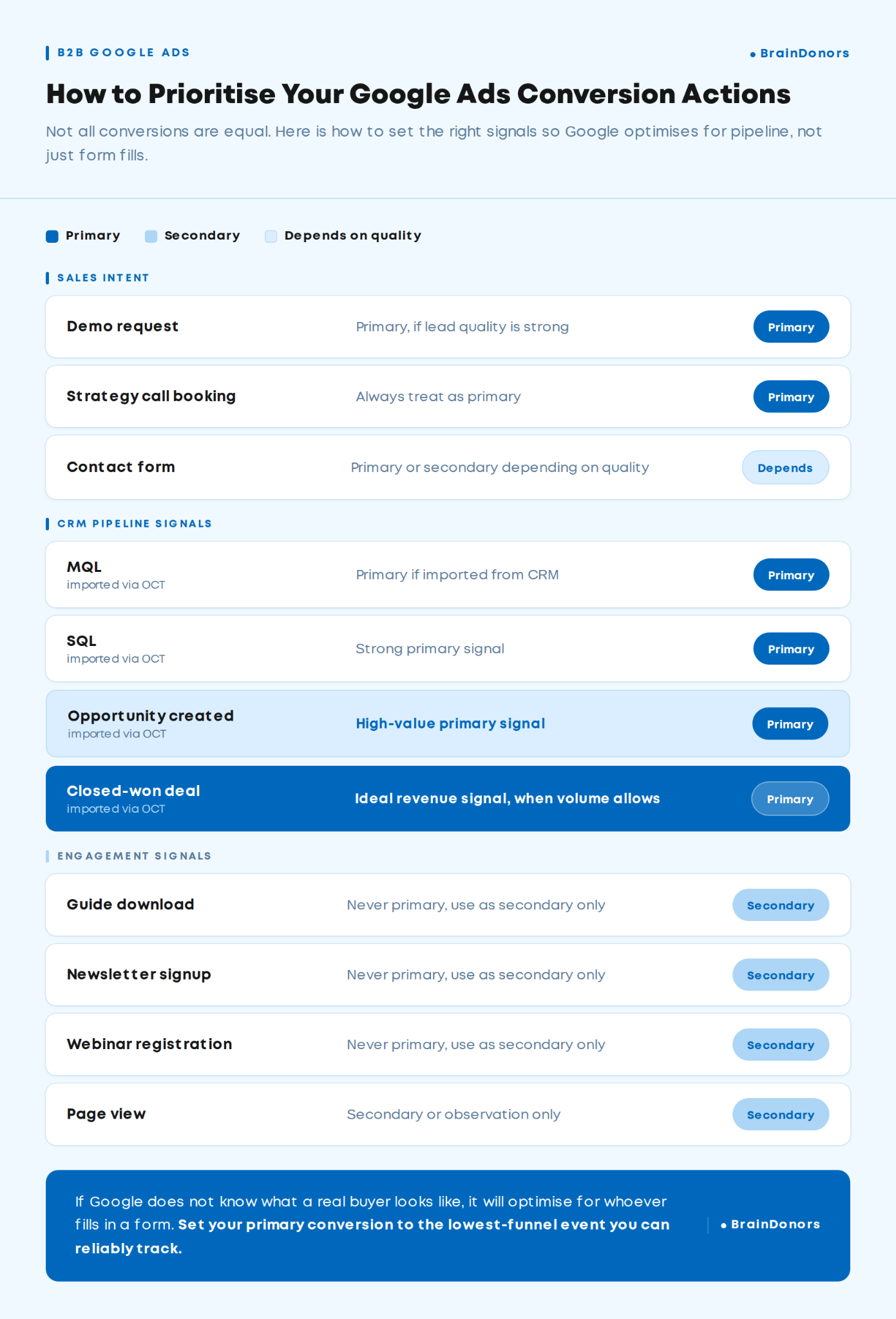
If the easiest conversion is a guide download, the account may start finding more guide downloaders. If the most valuable signal is an opportunity created, that is the signal the strategy should work toward.
This is one of the biggest differences between a campaign that generates activity and a campaign that supports pipeline.
BrainDonors tip: Do not let every conversion shout at the algorithm with the same volume. Demo requests, SQLs, and opportunities should not sit in the same bucket as page views and guide downloads.
The foundation for better B2B optimization is connecting your CRM to Google Ads through offline conversion tracking.
In simple terms, this means sending lead status updates from HubSpot, Salesforce, or another CRM back into Google Ads. Instead of Google only seeing that someone filled out a form, it can learn what happened after that conversion.
This is where tools like HubSpot become especially useful.
When the CRM is set up properly, Google Ads does not have to stop learning at the form fill. Lead source, campaign, keyword, lifecycle stage, sales qualification, deal creation, and closed-won revenue can all become part of the feedback loop.
We saw how important that visibility is firsthand with Meavo, where unifying sales, marketing, and service in HubSpot helped create 100% lead capture, 0 lost inbound inquiries, and full process transparency.

That means the team can see which campaigns are bringing in contacts, which contacts become MQLs or SQLs, which SQLs turn into opportunities, and which opportunities actually close.
For B2B teams, this changes the whole conversation. Instead of asking, “Which campaign generated the cheapest leads?”, the question becomes, “Which campaign generated the leads that moved through the CRM and became real pipeline?”
This is where Google Ads starts moving from lead generation to pipeline generation.
Smart Bidding can be powerful. But it is not magic, and it is definitely not a substitute for clean data.
One of the easiest ways to waste budget is to hand control to automation before the account has enough quality signals to learn from. If tracking is messy, conversion actions are too broad, or the account is still pulling in bad-fit traffic, automated bidding can simply optimize the wrong thing faster.
That is why bidding should match the maturity of the account.
The more down-funnel the conversion signal, the better the algorithm can become.
But there is a catch: you need enough volume for that signal to be useful. If the account only gets a handful of SQLs per month, moving too aggressively toward down-funnel bidding may limit learning.
So the question is not “manual or automated?”
The question is “what does the account know enough to optimize for right now?”
A B2B Google Ads strategy is not finished when the campaigns go live. That is when the real learning starts.
We usually optimize weekly across keywords, search terms, audiences, ad copy, and landing page signals. That also means testing ad angles, CTAs, landing page sections, and conversion paths, not just adding negatives and adjusting bids.
The goal is to keep improving the quality of traffic, not just the volume of conversions.
In the early stages, we usually stay closer to existing demand. That means prioritizing the longest and most transactional searches, protecting brand demand, and keeping the account controlled while the data gets cleaner.
Once the account starts producing results at the right cost, we can expand.
That may mean testing broader keywords, new match types, Performance Max, competitor campaigns, Demand Gen, YouTube, or AI Max campaigns, depending on the business, budget, and quality of the signals.
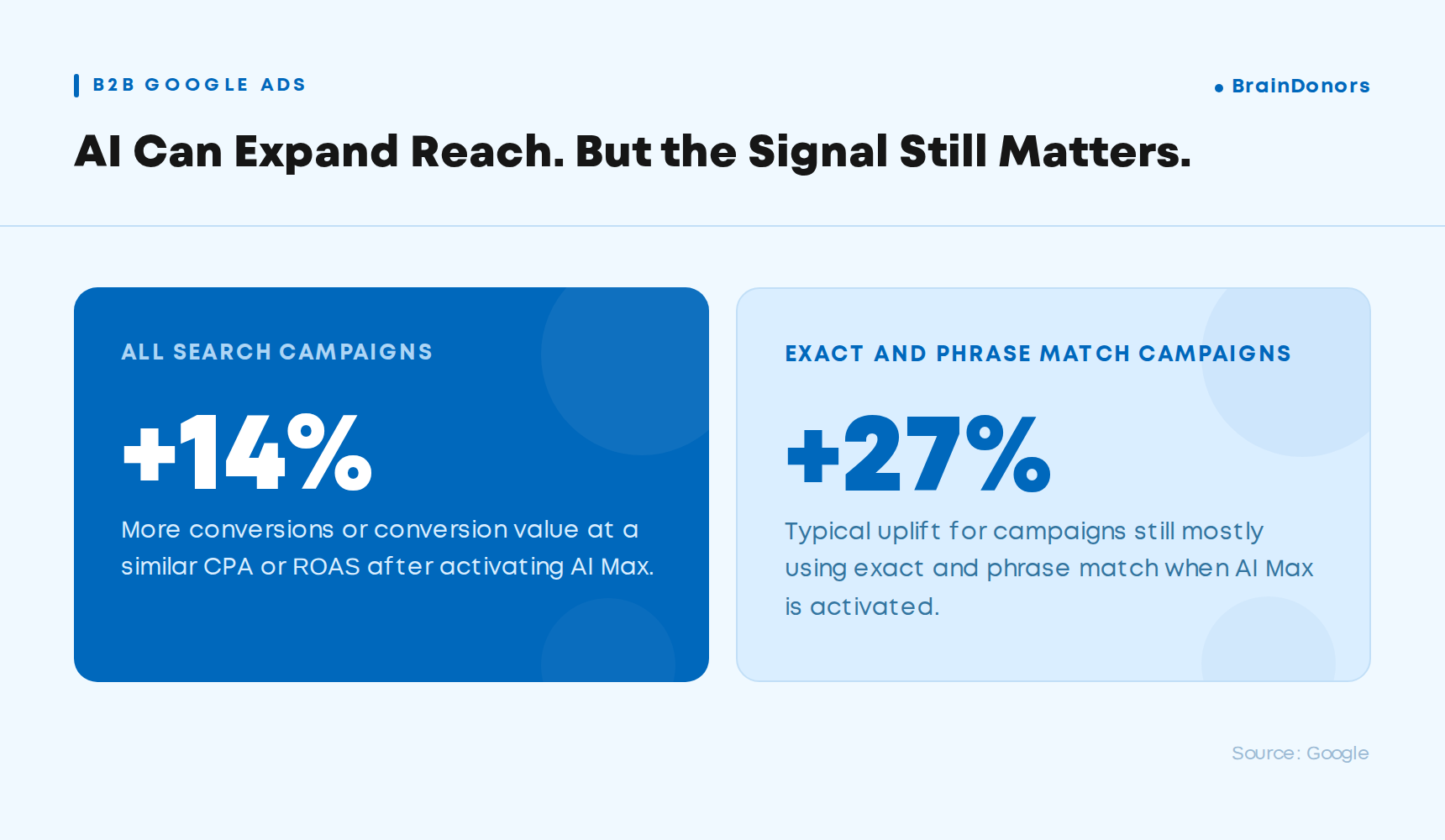
The important part is the order.
You do not scale by removing every restriction and hoping the account behaves. You scale when the account has enough evidence that it can bring in the right leads at a cost the business can sustain.
We saw this while working with Wisdom, a B2B client in the dental billing and insurance management space. The account did not scale because we simply pushed more budget into the same setup. It scaled because the strategy combined high-intent Google Ads campaigns, stronger keyword structure, targeted ad copy, specialized SEO strategy, better landing page direction, and clearer digital positioning.
The same approach helped Wisdom double CTR and increase conversions by 150%. As performance improved, the account also had room to scale budget from around $3K per month to $40K per month.

That is what healthy scaling looks like. Not spending more because the account is busy, but spending more because the account is showing that it can turn the right searches into stronger business outcomes.
Google Ads should not sit in a corner by itself.
In B2B, buyers rarely click one ad, fill out one form, and become customers. They compare. They leave. They come back. They see LinkedIn ads. They read SEO content. They ask internally. They search the brand name later.
So Google Ads needs to work as part of the wider demand generation system.
That can mean:
This is important because Google Ads often captures demand that other channels helped create.
If you only measure the last click, the picture can get distorted. Some channels may look stronger than they really are. Others may look weaker even though they influenced the buying journey.

There is no universal rule that says Google Ads should take 10% of your marketing budget.
The right budget depends on search volume, CPCs, deal value, conversion quality, sales cycle length, and how confidently the account can turn spend into qualified pipeline.
In some cases, Google Ads may take a much larger share of the media budget. In others, it may work better as one part of a wider demand generation mix.
The question is not only “how much should we spend?”
It is:
If the account is hitting profitable targets and there is still high-quality demand available, the question becomes less “how little can we spend?” and more “how much can we scale responsibly?”
Even when the strategy looks good on paper, a few common issues can quietly weaken performance.
CPL matters, but it should not be the only metric in the room.
For B2B, we usually look at performance across three levels: platform performance, lead quality, and pipeline impact. This gives you a clearer view of what is happening before the click, after the conversion, and inside the sales process.
These show whether your campaigns are reaching and engaging the right searchers.
These show whether the leads created by Google Ads match your qualification criteria.
These show whether Google Ads is contributing to real commercial outcomes.
The goal is not to ignore platform metrics. CPC, CTR, conversion rate, and quality score still matter.
But in B2B, they need context from CRM and sales data.
A campaign can look efficient in Google Ads and still underperform commercially. The stronger view is to connect platform performance with lead quality and pipeline outcomes.
If your campaigns are generating leads but sales is still questioning the quality, the problem may not be the channel.
It may be the system behind it.
At BrainDonors, we build B2B Google Ads strategies that connect paid search, landing pages, CRM data, and sales feedback into one pipeline-focused process.
Let’s find where your budget is working, where it is leaking, and what needs to change before you scale.
A B2B Google Ads strategy is a plan for using Google Ads to reach business buyers, capture search intent, generate qualified leads, and connect campaign performance to pipeline. It includes keyword research, targeting, campaign structure, ad copy, landing pages, conversion tracking, CRM feedback, and optimization.
Yes, Google Ads can be very effective for B2B when the strategy is built around search intent, lead quality, and pipeline. It works best when campaigns target buyers actively looking for a solution and when conversion data is connected to CRM stages like MQLs, SQLs, opportunities, and closed-won deals.
Start by defining your ICP, highest-priority offers, and qualification criteria. Then build campaigns around high-intent keywords, strong negative keyword lists, relevant ad copy, dedicated landing pages, and CRM-connected conversion tracking. The goal is not just to generate leads, but to understand which campaigns create sales-ready opportunities.
The main types of B2B Google Ads include Search campaigns for high-intent demand, competitor campaigns for comparison-stage buyers, remarketing campaigns for people who have already engaged with your brand, Performance Max for controlled expansion, Demand Gen and YouTube campaigns for awareness and retargeting, and brand campaigns to protect existing demand.
Google Ads mainly captures existing demand from people actively searching for a product, service, or solution. But it can also support demand generation through retargeting, YouTube, Demand Gen campaigns, and by working alongside SEO, LinkedIn Ads, content, sales outreach, and CRM-based attribution.