Contributors


Sales says the leads are junk. Marketing says sales never follows up. In most B2B SaaS companies we work with, both teams are partly right, and the real problem sits in the system between them.
Unqualified leads rarely come from one bad campaign. They come from small decisions that stack up: an ideal customer profile nobody uses, ad platforms trained on cheap form fills, a lead score that rewards opening emails, and a handoff that takes two days.
This guide explains why B2B lead qualification breaks and gives you 9 fixes you can start this quarter. Each one comes from patterns we see inside client CRMs and ad accounts.
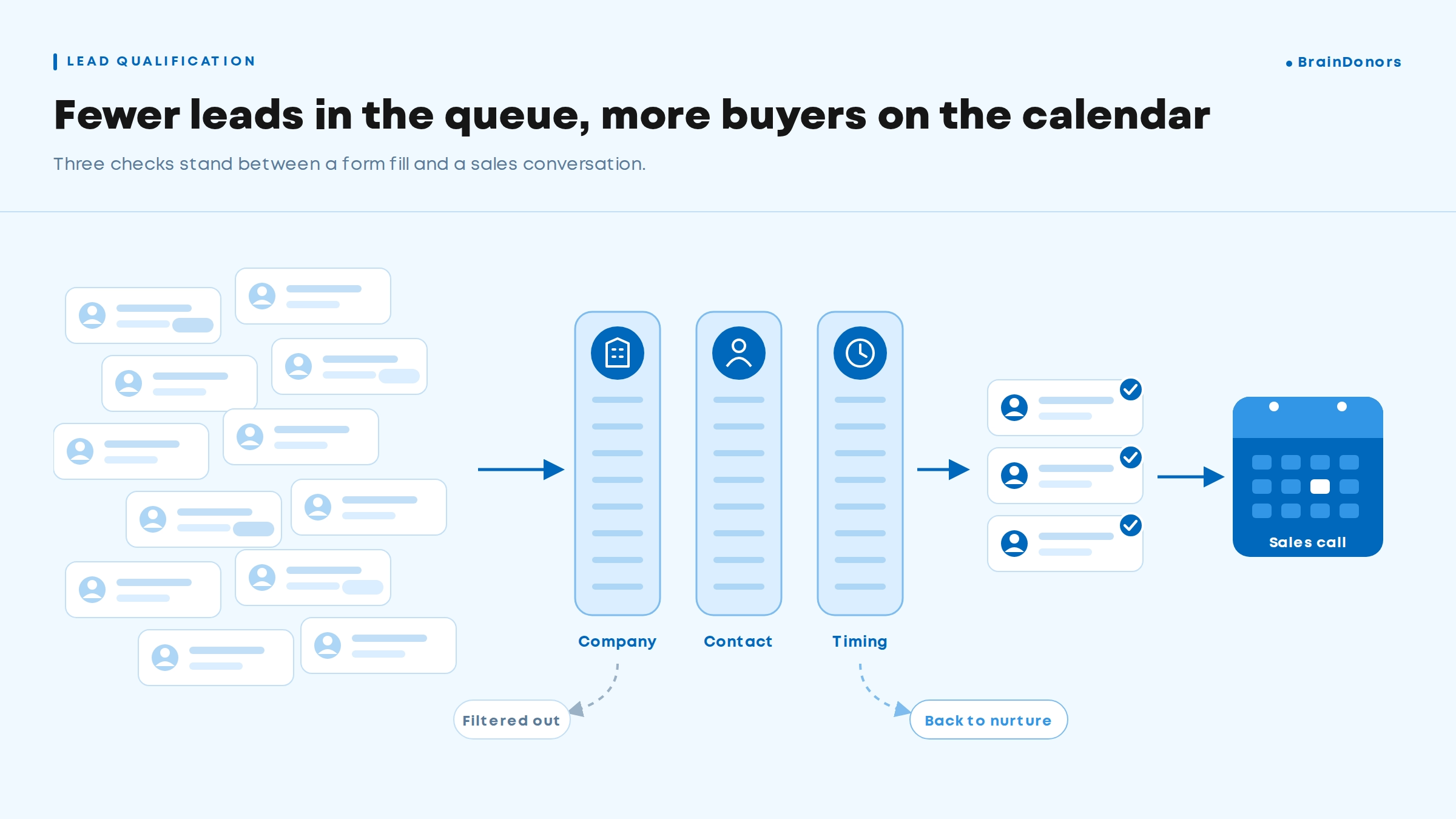
B2B lead qualification is the process of deciding whether a lead is worth sales time right now. It answers three questions: does this company fit what we sell, is this person part of the buying decision, and is there a reason to buy soon?
The hard part in B2B SaaS is that buying is a group decision. A typical buying group for a complex B2B purchase includes six to ten decision makers, and they spend only about 17% of their buying time meeting with potential suppliers.
So by the time someone fills in your form, most of the research is already done, often by people you never see in your CRM.
Most teams move leads through these stages:
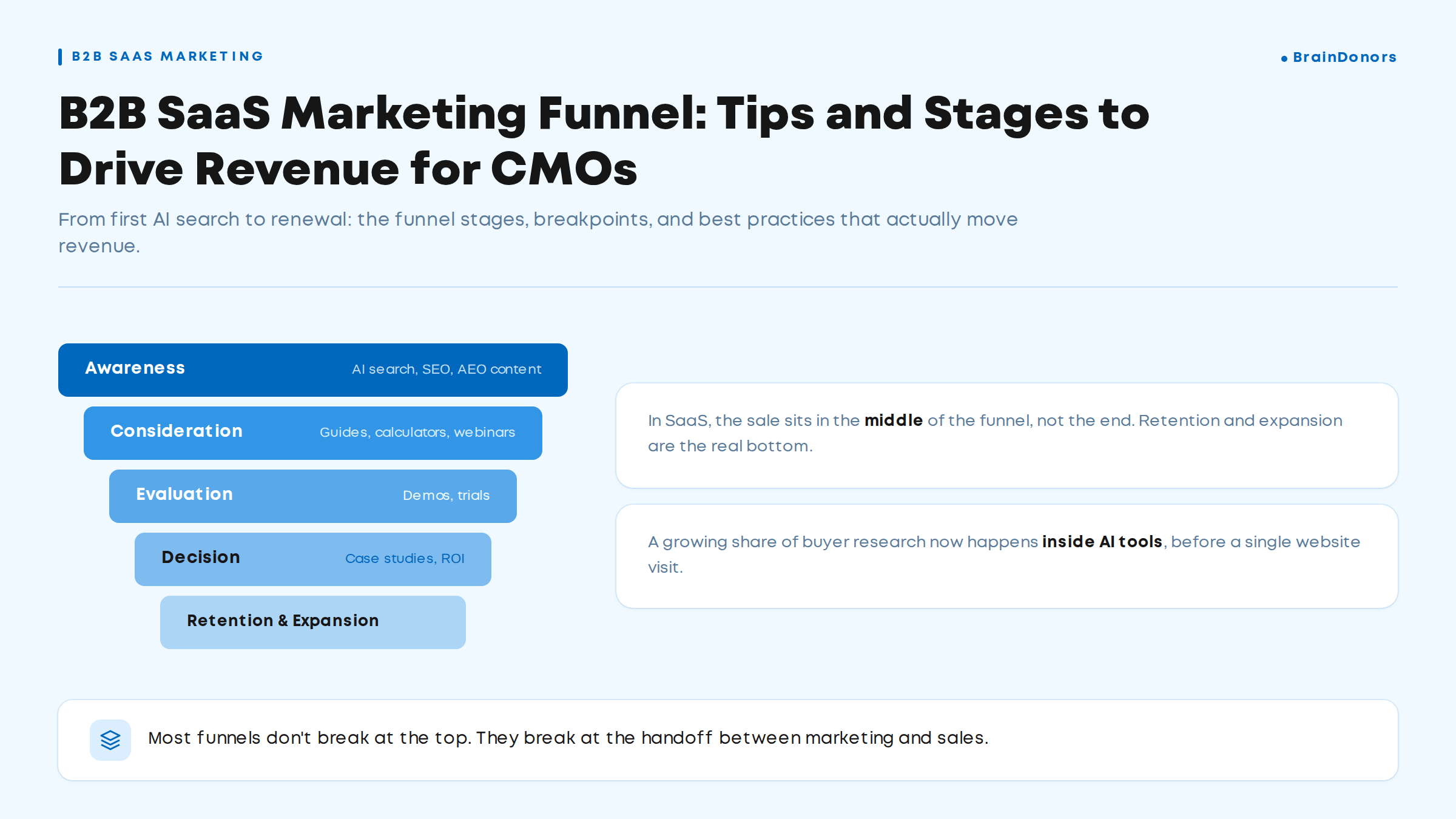
If you want the bigger picture of how these stages connect to revenue, our guide to the B2B SaaS marketing funnel covers each stage in detail.
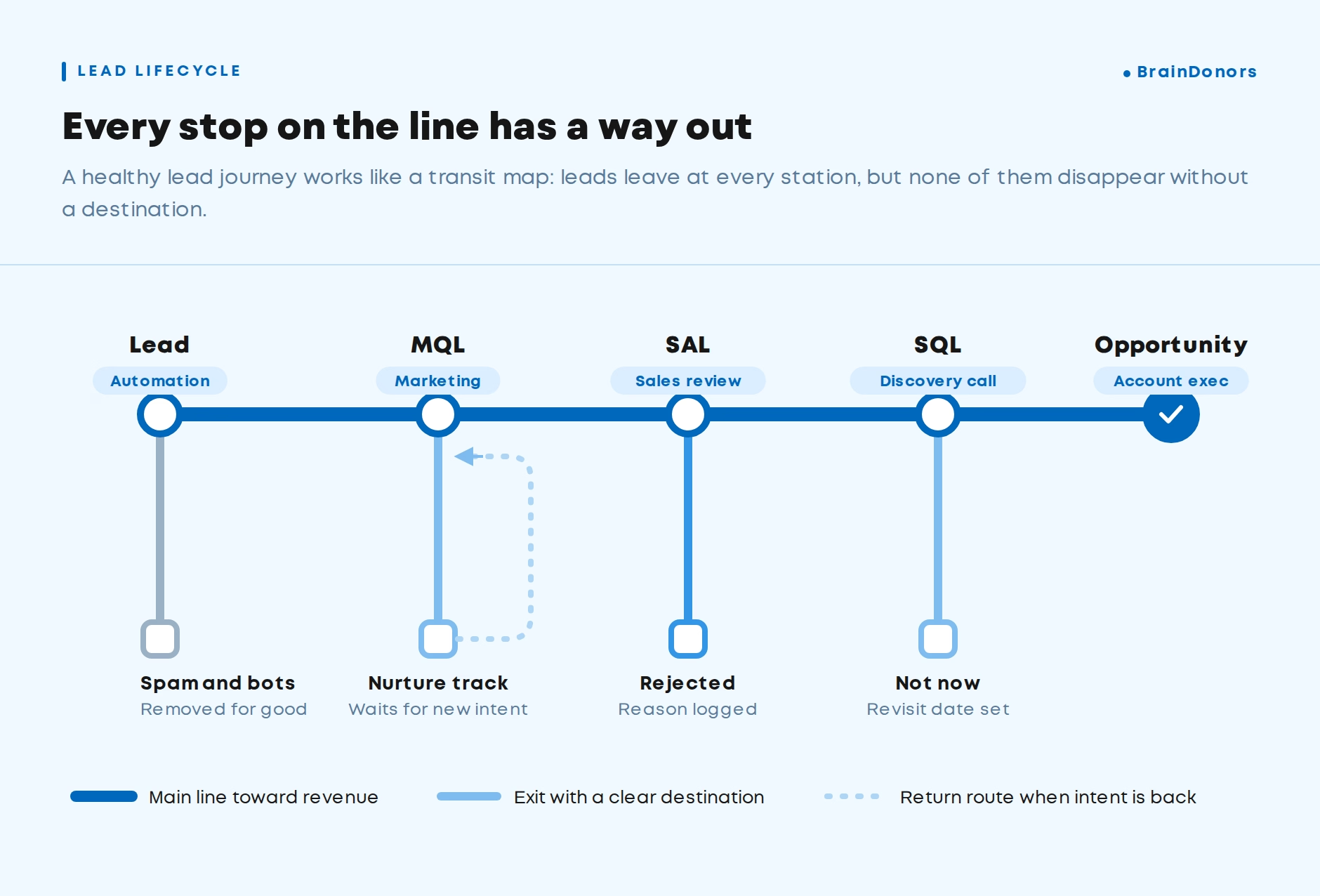
A qualified lead matches your ICP, has a real problem you solve, and includes at least one person who can move a buying decision forward. An unqualified lead fails at least one of those tests.
In practice, unqualified leads fall into four groups:
The fourth group is the easiest to fix, yet in our audits we still find demo forms with no bot protection at all. Adding reCAPTCHA or a hidden honeypot field, plus basic email validation, removes most of this noise quickly.
The first three groups need a clear process, and that is where most companies struggle.
Before you change anything, pull your recent bad leads and trace each one back to its source. The nine reasons below follow the path a lead takes, from who you target to how fast sales responds.

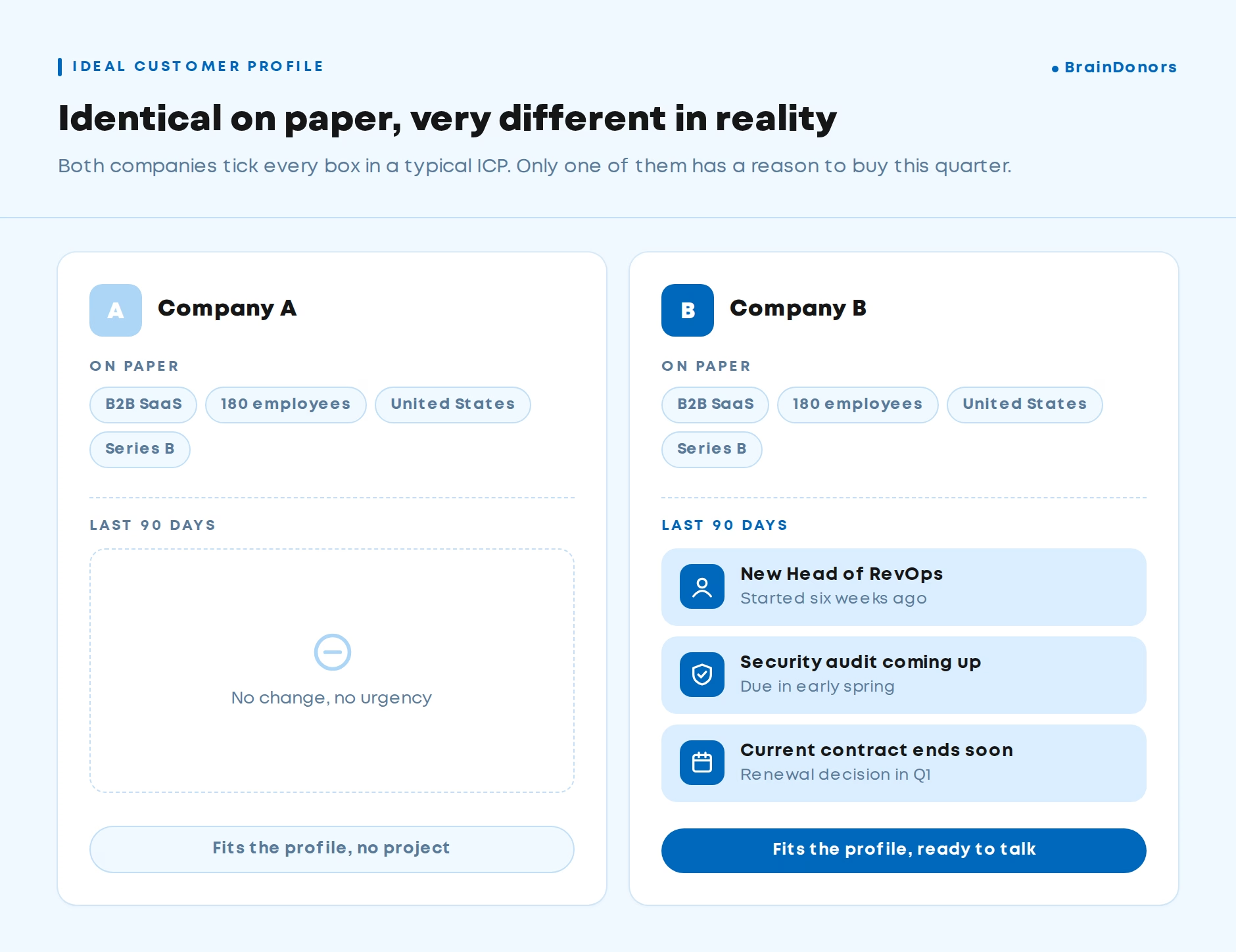
Most ICP documents read like a targeting brief: “SaaS companies, 50 to 500 employees, US and UK.” Thousands of companies match that description, and most of them will never buy from you.
A useful ICP describes the situation that makes someone buy. Think of triggers like a new funding round, a first hire in a specific role, an upcoming compliance deadline, or a team that has outgrown spreadsheets.
The fix: Pull your last 20 to 30 closed-won deals and your last 20 closed-lost deals. Look for what the winners had in common before they bought: the trigger, the size of the team that uses your product (instead of total headcount), the tools they already had, and who signed the contract.
Then write an anti-ICP. This is a short list of companies you will not pursue, even when they ask for a demo. It gives marketing clear exclusions for targeting and gives sales permission to say no.
Ask five people in your company to define an MQL, and you will often get five answers. When marketing passes leads based on one definition and sales judges them by another, every handoff turns into an argument.
The fix: Write a one-page lead qualification agreement. It should include:
The disqualification reasons are the most valuable part. After a month, they show you exactly which campaigns and channels create bad leads.
We saw this with Duality Technologies, a secure AI company where sales worked in Salesforce and marketing in Pardot. Leads only moved to sales after a certain stage, and nobody could measure how long a lead sat in the sales accepted stage. After we moved both teams into one HubSpot setup with shared stage definitions, a new scoring model, and SAL tracking, lead quality improved 3.5x.
When marketing’s main target is a number of MQLs, the system finds ways to produce MQLs. The score threshold drops, another ebook goes live, a broad webinar gets promoted. The number goes up, and sales trust goes down.
The fix: Move marketing targets further down the funnel. Report cost per SQL and pipeline created by channel next to cost per lead. A channel with expensive leads and a high SQL rate is usually worth more than a cheap channel that sales ignores.
The Journey, a VC-backed platform that combines CEO consulting with an AI software product, shows why this matters. We built separate funnels for its two offers and tracked booked meetings instead of form fills alone. The results included 166% more new requests, 80% more booked meetings, and a 50% lower cost per lead.
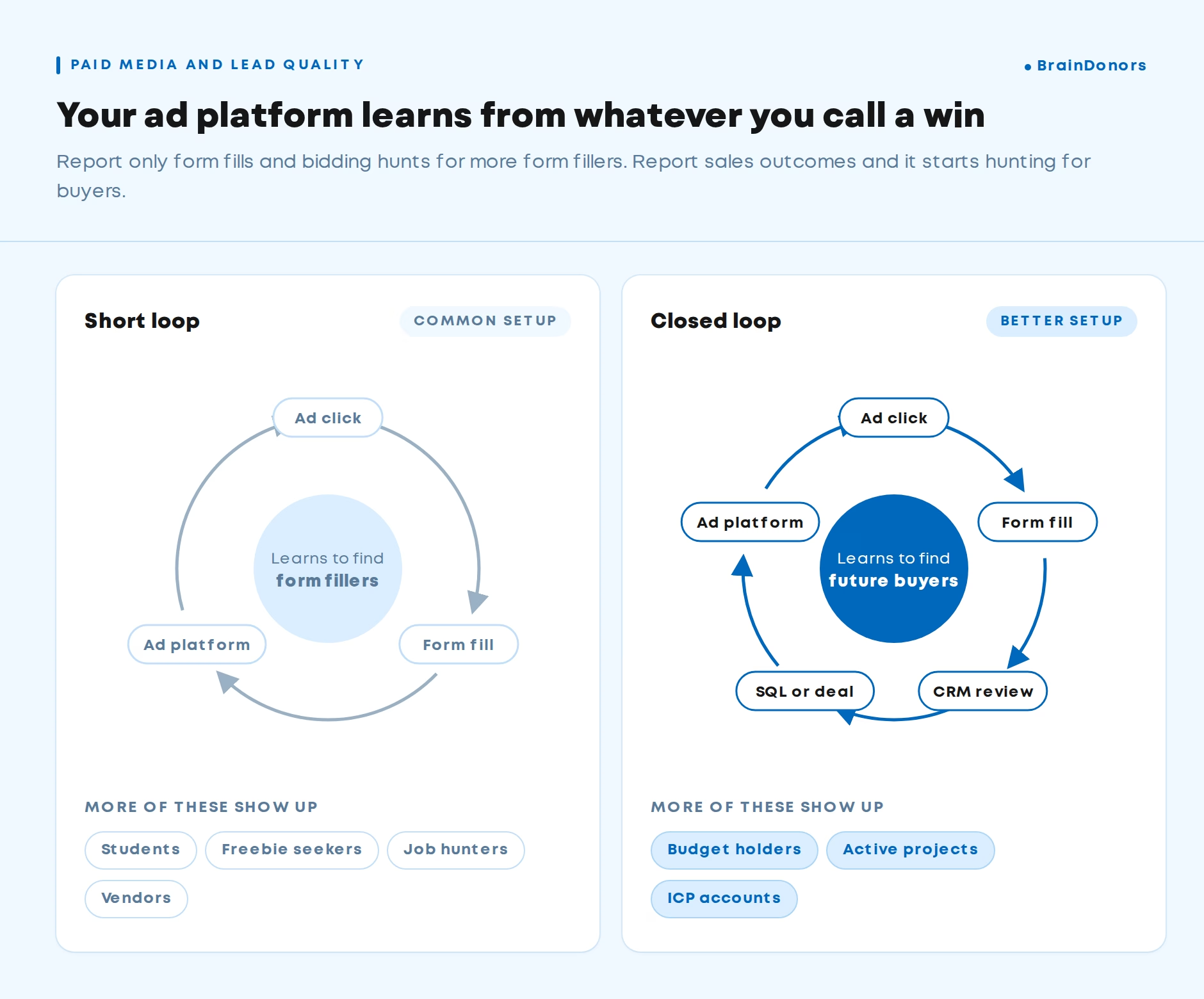
Google Ads, LinkedIn, and Meta learn from the conversions you send them. If the only conversion is “form submitted”, the algorithm looks for people who are likely to fill in forms. Those are often not the people most likely to buy.
This is one of the first things we check when we take over a paid account. Campaigns are often set to bring in as many leads as possible, with nothing telling the platform which of those leads were any good. Lead volume grows, cost per lead drops, and the sales team gets busier with calls that go nowhere.
The other half of the problem is the traffic itself. We often find search terms and LinkedIn targeting that only loosely match the product: an invoicing tool bidding on “free invoice template”, or a security platform showing ads to anyone with “IT” in their job title. When the traffic is wrong, no scoring model further down the funnel can rescue it.
The fix: Send CRM outcomes back to your ad platforms. In Google Ads, enhanced conversions for leads lets you import qualified leads and closed deals, so bidding can learn which clicks turn into pipeline. Give SQLs and opportunities a real value, and shift bidding toward those events once you have enough volume.
Then review your search terms report and audience settings, and cut anything that does not match your ICP. When we restructured Wisdom’s Google Ads around high-intent keywords for dental billing and added landing pages built to convert, its conversion rate rose 150%. For the full approach, see how we build a B2B Google Ads strategy.
Someone who downloads a report on SaaS security trends is interested in a topic. That does not mean they want a sales call. Yet many scoring setups turn every content download into an MQL within minutes.
Buyers do most of their research on their own, before they ever speak to a vendor. A download is often part of that research, sometimes by a person who will never be in the buying group.
The fix: Stop auto-qualifying content downloads. Keep those contacts in a nurture track and let fit plus later intent signals decide when they reach sales.
Ungate top-of-funnel content where you can, and keep forms for assets that signal buying intent, such as ROI calculators, implementation guides, or pricing breakdowns. Our field-tested demand generation playbook explains how to build demand without relying on gated content.
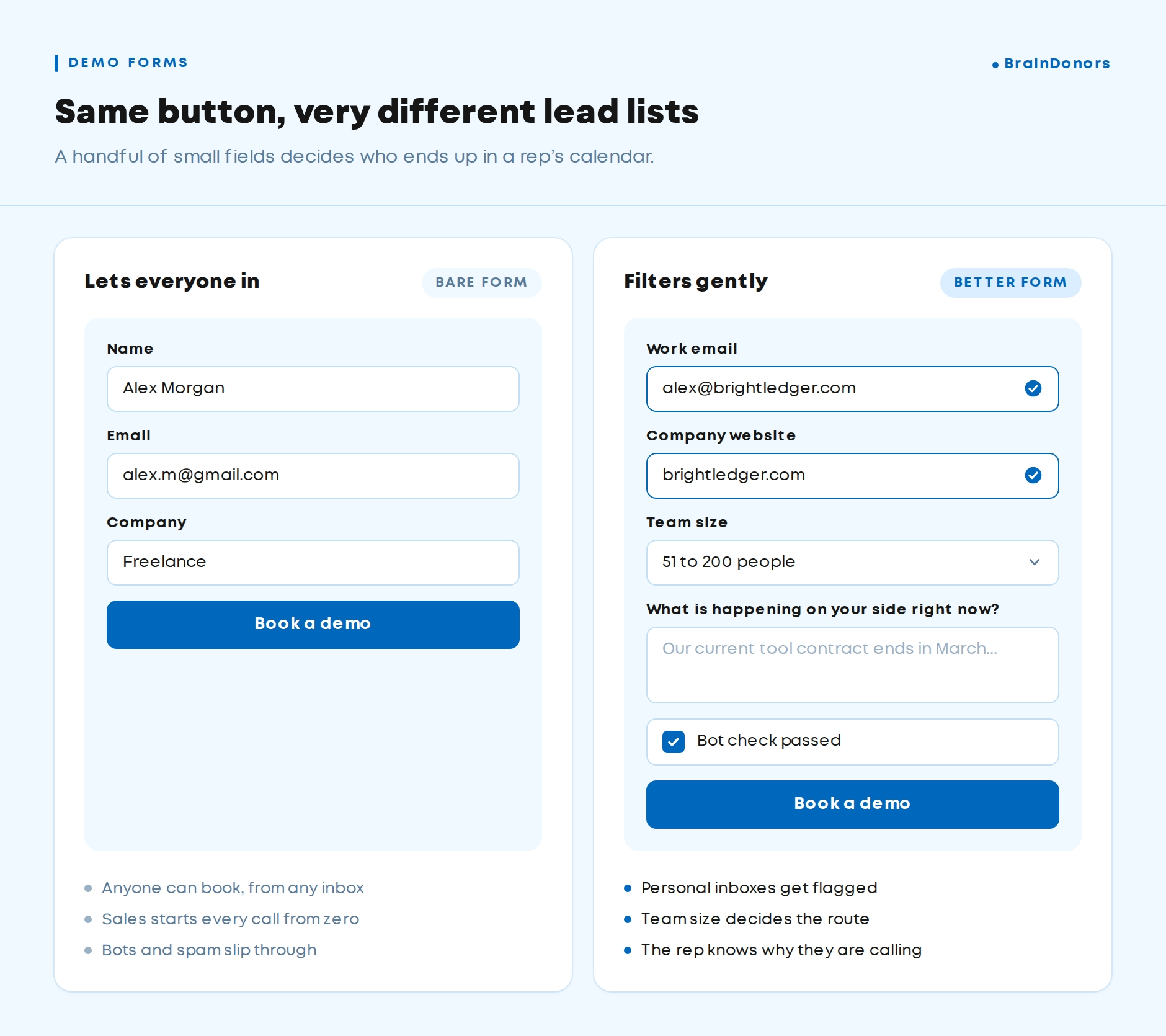
A demo form that asks only for name, email, and company gives sales nothing to work with. The rep has to qualify from zero, often on a call the prospect expected to be a product demo.
The opposite problem exists too. A form with 12 required fields scares off good buyers and still misses the one question that matters.
When we trace unqualified leads back to the website, we usually find one of two things. Either the messaging is so broad that almost anyone could think the product is for them, or the form is so short that it lets everyone through.
The fix: Ask fewer, better questions. Use data enrichment to fill in company size and industry automatically, and save your form fields for context only the buyer can give:
• How many people would use the product?
• What are you using today?
• What made you start looking now?
A few light filters also help. We usually recommend asking for the company name and website URL and requiring a business email address. A Gmail address is not always a bad lead, but for most B2B SaaS products it is an early warning sign worth catching.
Then route leads based on the answers. A 200-seat team switching from a competitor should reach a senior rep within minutes. A two-person team might be better served by a self-serve trial.
Finally, check the page copy itself. Clear “built for” statements, typical team sizes, and pricing guidance help the wrong buyers rule themselves out before they ever reach the form.
Many lead scoring models were built years ago and never updated. They give points for email opens, newsletter clicks, and blog visits, and they rarely subtract anything.
Email opens are now a particularly weak signal. Apple’s Mail Privacy Protection loads email content in the background, which can register an open even when nobody reads the email.
Security tools that scan links in corporate inboxes can also create clicks that no human made. A lead can look engaged without ever showing up.
The fix: Split your score into two parts: fit (who they are) and engagement (what they do). HubSpot’s lead scoring tool, for example, supports separate fit and engagement scores. Then weight each signal by how close it sits to a buying decision:
Add score decay, so points fade when nobody engages for a few weeks. A burst of activity from six months ago should not keep a lead in the MQL queue today.
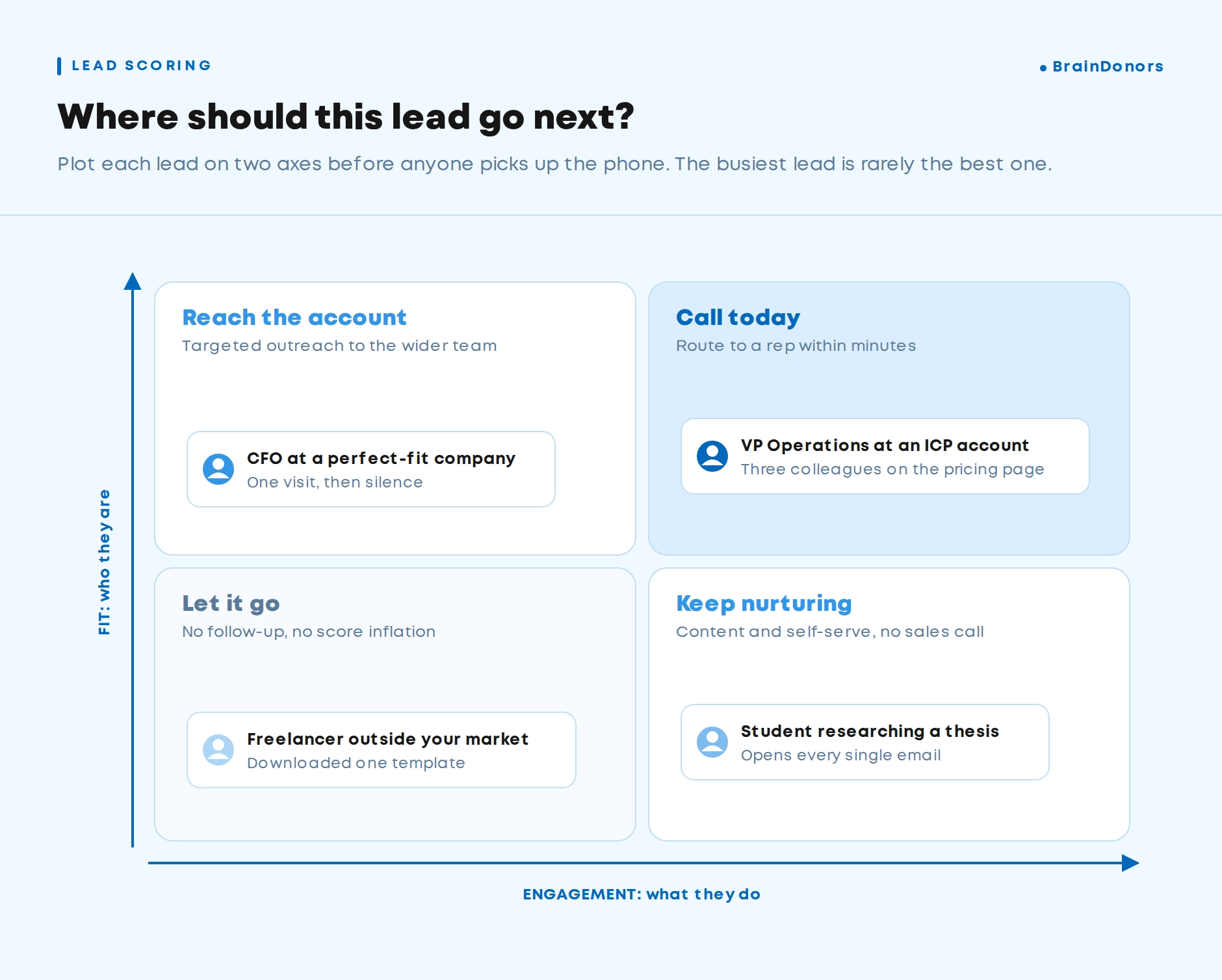
Imagine three people from the same company visiting your pricing page in one week. Each one scores below the MQL threshold, so nobody in sales hears about it. Meanwhile, a single contact at a poor-fit company downloads two ebooks and lands in a rep’s queue.
That happens when scoring only looks at individual contacts. With six to ten people in a typical buying group, the account is the better unit to watch.
The fix: Associate every contact with a company record and roll engagement up to the account level. Set an account-level threshold, so several medium signals from one company can trigger a handoff.
For product-led SaaS, add product data to the picture. Seats added, teammates invited, and usage limits reached are often stronger buying signals than any marketing activity.
Imagen AI, an AI photo editing platform built on product-led growth, added a sales-led channel for high-value enterprise customers. We built the full lead-to-close process in its existing HubSpot account and aligned it with its Snowflake data, so sales and revenue reporting worked from the same numbers. In its first year, the new channel hit 100% of its sales targets.
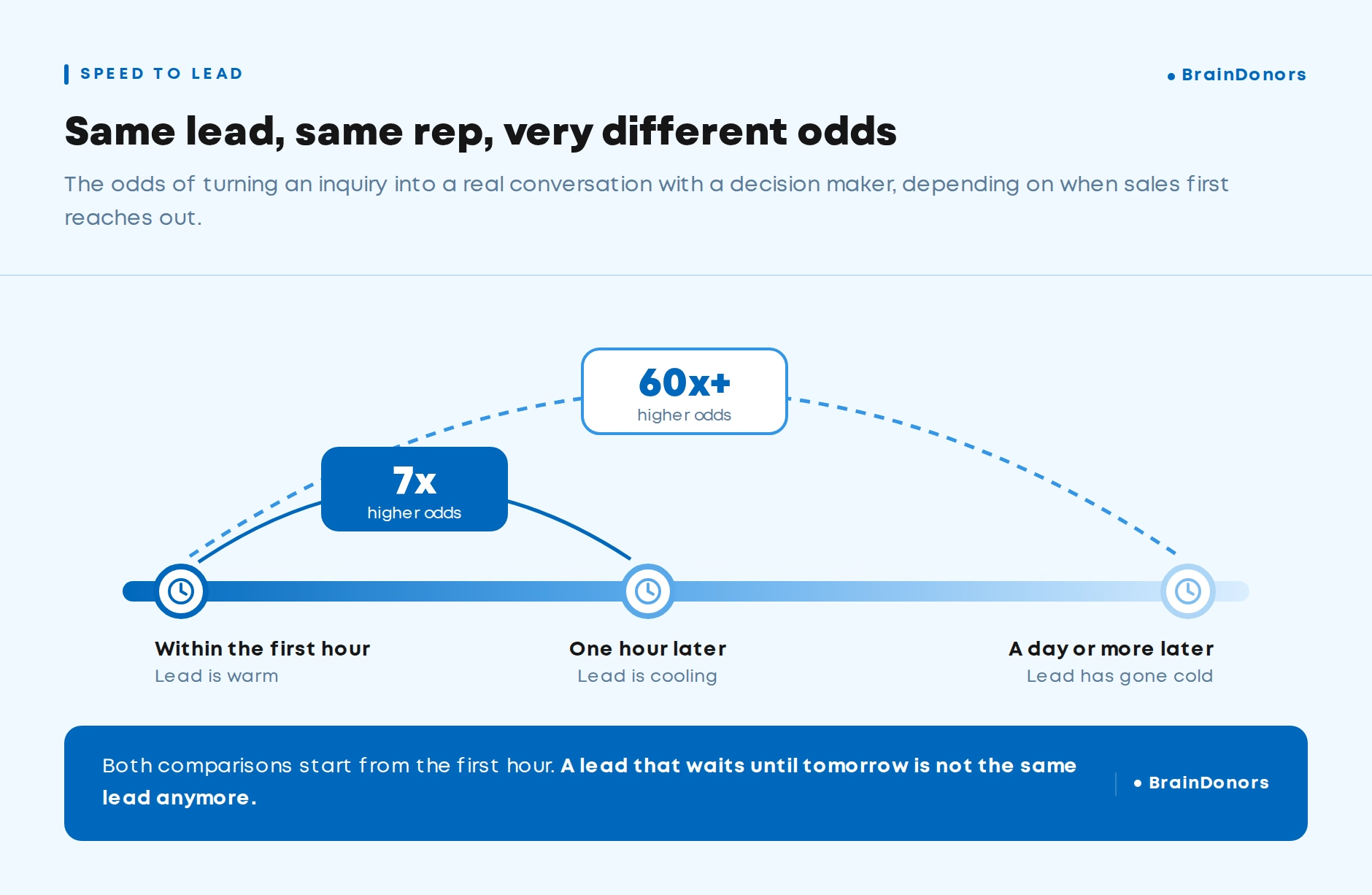
Some leads are qualified when they arrive and unqualified two days later. A slow handoff loses deals, and it also fills your reports with “bad leads” that were good when they came in.

The causes are usually structural: leads pulled from the CRM once a day, routing by territory or “fairness”, no owner over the weekend, and reps who prefer working their own outbound leads.
The fix: Route leads instantly based on fit and form answers, assign an owner automatically, and set an SLA with alerts when a lead goes untouched. Track time to first touch as a core metric, next to MQL and SQL volume.
Meavo sells across many countries, and its leads were often misrouted or lost between regional teams and separate tools. After we brought sales, marketing, and service into one HubSpot setup with automated routing and standard qualification rules, Meavo reached 100% lead capture with zero lost inbound inquiries.
For most B2B SaaS teams, there is no single best framework. The setup that works best uses a light framework early and a heavier one later in the deal.
In practice, many SaaS teams combine them. Marketing handles fit through the ICP and lead scoring. SDRs use CHAMP or BANT on the first call. Account executives use MEDDPICC once an opportunity is open.
Use this lead qualification checklist before passing any lead to sales. If a lead fails two or more checks, it belongs in nurture, not in a rep’s queue.
The clearest sign is simple: sales stops re-qualifying every lead from scratch. To track progress properly, review these numbers every month:
Compare each metric with your own baseline from previous quarters. Benchmarks vary too much by deal size and sales motion to be useful on their own.
Unqualified leads are a symptom. The causes are usually a vague ICP, mismatched definitions, ad platforms learning the wrong goal, outdated scoring, and slow handoffs.
Start with the cheapest fix: make a disqualification reason required in your CRM this week. Within a month, you will know which of these nine problems is costing you the most pipeline.
An MQL fits your ideal customer profile and has shown enough interest for marketing to pass it on, usually based on lead scoring. An SQL has been checked by sales, typically through a conversation that confirmed need, authority, and timing. The MQL is marketing’s best guess, and the SQL is sales’ confirmation.
Tier your leads instead of cutting them. Keep generating leads, but send only high-fit, high-intent leads to sales and move the rest into nurture. Feeding SQL and deal data back into your ad platforms also helps, because bidding shifts toward better-fit buyers without shrinking your budget or reach.
Yes, mainly in three areas: enriching records with company data, building predictive scores from past wins, and summarizing intent signals for reps before a call. AI still needs clean CRM data and a clear definition of a qualified lead. Without both, it learns from your existing mistakes.
Start with the problem: what are you trying to solve, and what happens if nothing changes? Then ask who else is involved in the decision, what they use today, and whether there is a date this needs to be solved by. These four questions cover need, authority, competition, and timing without sounding like a checklist.
Lead scoring is one part of lead qualification. A score ranks leads automatically based on fit and behavior, so marketing knows who to pass on. Qualification is the full decision, including the scoring rules, the handoff criteria, and the conversation where sales confirms there is a real project.